
Most phone launches this year are a race to cram in a bigger battery, a hotter chip, or a sharper camera. The Fairphone 6+ goes the other way. Instead of chasing numbers, it wants to be the phone you keep for half a decade — the one you can actually take apart and fix yourself.
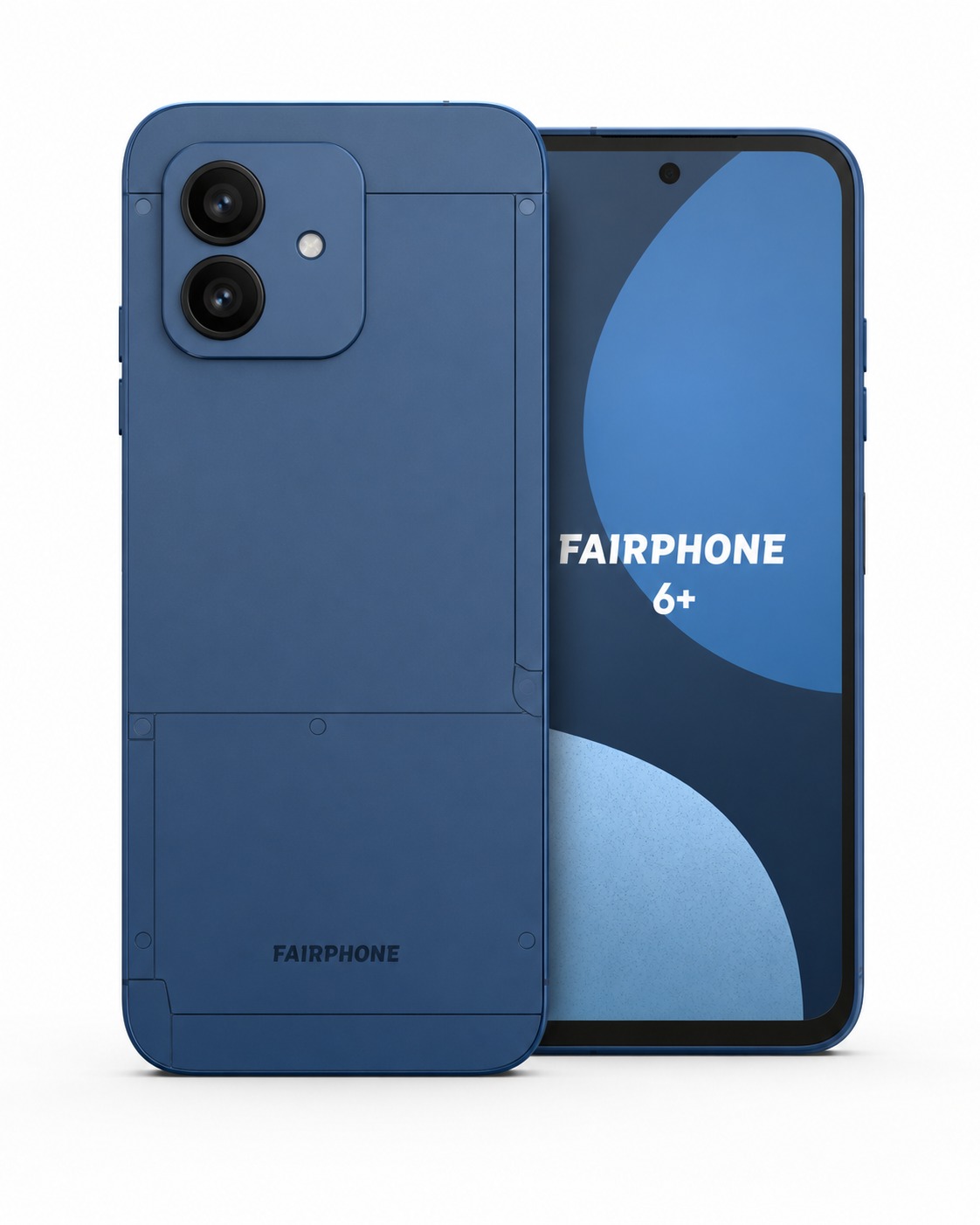
The 6+ is a modest, honest refresh of the Fairphone 6 that shipped in June 2025: RAM jumps from 8GB to 12GB, the chip moves from a Snapdragon 7s Gen 3 to the newer 7s Gen 4, and there’s a fresh Cobalt Blue option. Everything else that made the 6 special — the 12 replaceable parts, the five-year warranty, the promise of software support well into the 2030s — carries over unchanged.
The real headline is that, for the first time ever, you can buy a Fairphone directly in the United States at $649, from both the company’s store and Amazon, with a fully standard Google-loaded Android build. It’s been years in the making for the Dutch company, and it lands at a moment when consumers are tired of paying more for gadgets that get harder to repair.
Design & Build Quality
Pick up the 6+ and it feels familiar if you’ve handled any recent midrange phone: a 6.16 x 2.89 x 0.38-inch slab that weighs 193 grams. That’s not featherweight, but it’s a fair trade for a handset that’s built around modularity. The aluminum frame is solid, and the removable back panel is held in place by real screws — a rarity in 2026.
The phone ships in Cobalt Blue (new), Forest Green, and Horizon Black. The rear is flat and cleanly laid out, though it’s worth noting there’s no camera bump styling to speak of — the two lenses sit flush in a simple arrangement.
Durability is a step ahead of most rivals at this price. Fairphone rates the 6+ for IP55 splash and dust resistance (low-pressure water jets, not full submersion) and backs it with a MIL-STD-810H rating, drop-tested at 1.5 meters. A Gorilla Glass 7i panel protects the front. It won’t survive a swim like an IP68 flagship, but it shrugs off rain and the occasional fumble far better than the glass slabs that dominate the 7,000mAh crowd we’ve been reviewing, like the Tecno Camon 50 Ultra.
Display
Fairphone fitted a 6.31-inch LTPO AMOLED with a 1116×2484 resolution — about 431 pixels per inch in a 20:9 aspect ratio. It’s a 10-bit panel covering sRGB and DCI-P3, and the adaptive refresh rate swings from a battery-friendly 10Hz up to a smooth 120Hz.
Brightness peaks at around 1,400 nits in auto mode, which is plenty for glaring afternoon sun, and it drops to a 2-nit floor for late-night reading. There’s HDR10 support, an always-on display, and wet-finger tracking plus a glove mode — small touches that matter in a rainy, humid country. Eye-care crowd gets 1,440Hz PWM dimming below 90 nits and DC dimming above it.
It’s a good panel, not a spectacular one. The 1116×2484 resolution is a little under the 1220p+ panels some rivals ship, but at this size you’ll struggle to notice unless you’re pixel-peeping side by side.
Performance
Under the hood sits the Snapdragon 7s Gen 4 (SM7635PRO), a 4nm midrange chip with an octa-core CPU — one prime Cortex-A720 core plus three performance cores and four efficiency cores — and an Adreno 810 GPU running at 940MHz. Paired with 12GB of LPDDR5 RAM and 256GB of UFS 3.1 storage, it’s a comfortable daily-driver setup.
Let’s be direct about what this isn’t: it’s not a gaming flagship, and it’s not trying to be. You’ll get smooth scrolling, snappy app launches, and capable multitasking, but don’t expect flagship-tier frame rates in the heaviest titles at max settings. The 7s Gen 4 is the same class of silicon found in competent midrangers, and the 6+ asks you to value longevity and repairability over raw benchmark headroom.
Storage is one place Fairphone is generous: 256GB built in and a dedicated microSD slot that accepts cards up to 2TB. Combined with a removable battery, that’s a hardware package genuinely built to outlast the contract it was sold under.
Camera
Imaging is the 6+’s most polarizing area. The main shooter is a 50MP Sony LYTIA LYT-700C sensor with an f/1.88 lens, 1/1.56-inch sensor size, and both optical and electronic stabilization. It captures solid daylight shots with good detail and natural color. The 32MP front camera has autofocus and handles selfies well.
There’s no telephoto. Instead, the secondary camera is a 13MP ultrawide with a 120-degree field of view and f/2.2 aperture. I can’t help but agree with reviewers who’d have preferred a portrait telephoto over the second wide lens — for a phone pitched at years of everyday use, 2x zoom is handled by in-sensor cropping and 10x digital zoom, which is fine for casual snaps but not a substitute for optical reach.
Low light is the honest weak point. In dim conditions the 6+ will lean on its 50MP sensor hard, and while results are usable, they trail the night modes of dedicated camera phones in this price bracket. Expect “good enough” rather than “wow.” Video tops out at 4K30 on the main camera, with 1080p options and gyro-EIS to keep things steady.
Battery & Charging
The 4,415mAh cell is deliberately modest compared to the 7,000–10,000mAh endurance monsters we’ve covered this month — the Oppo A7 Pro Max packs 10,000mAh. Fairphone instead emphasizes that the battery is removable and rated for more than 1,000 charge cycles while retaining 80% of nominal capacity. That’s the longevity pitch in physical form.
Fairphone quotes up to two days of battery life for typical use. Charging is 27W fast charging with a 30W peak, reaching 50% in roughly 30 minutes and a full charge in about 85 minutes. It supports QC 2/3/4+, USB PD, and PPS, plus an Eco Charge mode and a charge limit with pass-through at 80% to baby the cell. There’s no wireless charging, which is a real miss at this price given how many rivals now include it (including the Motorola Edge 70 Max with Qi2.2).
Software
The 6+ ships with Android 16 and a commendable commitment: six major Android updates promised through 2032, plus security support that extends to 2033. No preinstalled third-party bloat beyond the Google suite and a small “My Fairphone” app. That clean, long-lived software experience is arguably the strongest argument for buying this phone — most rivals promise far fewer years.
Compare that to budget champions like the Realme 16x, which offers only two years of OS updates, and the software story here is a different class entirely. If you’ve ever been burned by a phone quietly losing support after two years, the 6+ is aimed squarely at you.
Repairability & Sustainability — The Real Story
Here’s where the 6+ leaves every other phone in the dust. It has 12 user-replaceable parts, and you can swap the USB-C port, battery, display, and back cover in under five minutes with a single T5 Torx screwdriver. Microphones, side buttons, and the fingerprint sensor are repair-center serviceable. Fairphone guarantees spare parts until 2033 and pairs that with a five-year warranty — category-leading support terms.
The phone also carries genuine sustainability credentials: about 51% fair or recycled material by weight across 15 materials, including fairmined tungsten and gold, and a carbon footprint of roughly 30kg of CO2e per unit. It’s not a marketing afterthought, it’s the core of the product — and it’s why the iFixit community holds Fairphone up as the benchmark for repairable design.
Pros and Cons
| Pros | Cons |
|---|---|
| 12 user-replaceable parts, five-year warranty | Not officially sold in the Philippines |
| Six Android updates through 2032, support to 2033 | No telephoto camera — ultrawide only |
| Removable 4,415mAh battery rated for 1,000+ cycles | No wireless charging |
| 12GB RAM + faster Snapdragon 7s Gen 4 | 30W charging is slow by 2026 standards |
| Dedicated microSD slot up to 2TB | IP55 splash resistance, not IP68 waterproof |
| Clean Android 16 with no bloat | Premium price for midrange internals |
Should You Buy This?
Buy it if
- You want a phone you can repair yourself and keep for five or more years.
- You value long software support — six Android updates and security to 2033 — over the latest spec bump.
- You care about sustainable, fairly-sourced materials and are willing to pay for them.
- You buy in the US or Europe, or can import with confidence, and want a modular, expandable daily driver.
Skip it if
- You live in the Philippines and expect local retail, warranty, or service — none of that exists here yet.
- You need a telephoto camera or serious low-light photography performance.
- You’re a power user who wants flagship gaming performance or 100W-class charging.
- You compare purely on price-to-spec (the Redmi Note 17 Pro and similar offer more raw hardware for less).
Final Verdict
The Fairphone 6+ is a phone you buy with your principles, not your benchmark scores. At roughly ₱40,000–42,000 if you import it, it’s not a value proposition in the traditional sense — you can get more RAM, more battery, and a telephoto for less money from any of the battery-first brands flooding the PH market right now.
What you’re paying for is the anti-obsolescence promise: a device with replaceable parts, a removable battery, a five-year warranty, and software supported into the 2030s. If that genuinely matters to you — and for a lot of people financially, it should — the 6+ is the most honest phone of its kind on the market.
For most Filipino readers, though, the verdict is complicated by availability. With no official local retail or service center, importing the 6+ means shouldering shipping, customs, and the risk of warranty logistics across borders. It’s a great phone for the right person — the question is whether that right person currently lives in a market Fairphone actually serves.