
The Fairphone 6+ asks a question almost no other phone company wants to touch: what happens when this breaks? Most makers would rather you think about the next upgrade. Fairphone built the entire 6+ around the opposite idea — a device you are supposed to open, repair, and keep. Announced August 18, it marks the first time a Fairphone is officially sold in the United States, and it is the brand’s loudest case yet that longevity beats the upgrade treadmill. I’ll be straight with you up front: measured purely on paper, the 6+ is a mid-ranger carrying a near-premium price. Measured by what it costs to own over five years, it tells a very different story.
Design & Build Quality
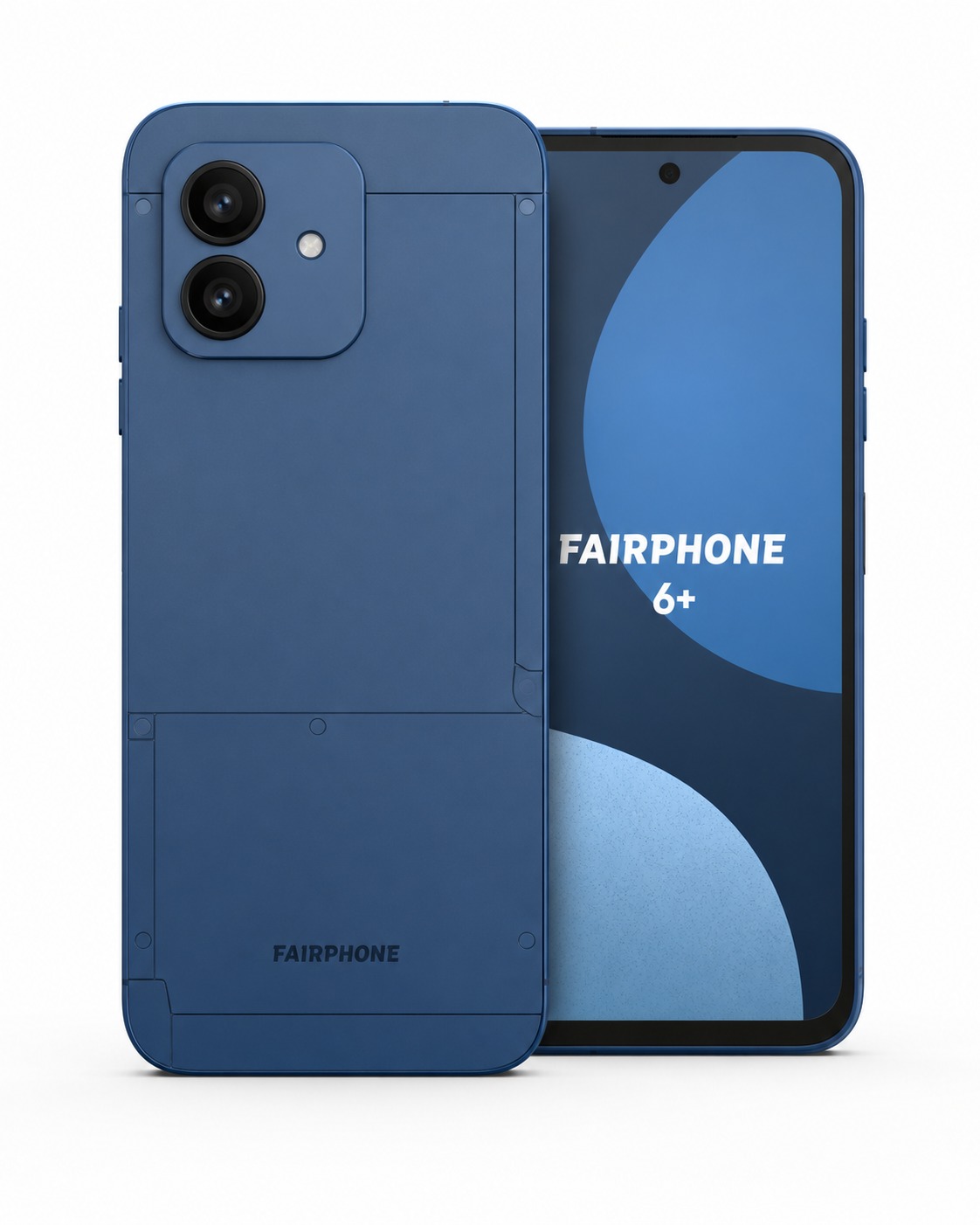
The design brief here is “made to be opened,” and Fairphone wears it proudly. The back cover pops off with a fingernail, and underneath sit 12 user-replaceable parts. Four of them — the USB-C port, battery, display, and back cover — swap in “under five minutes” with a single screwdriver, per Fairphone. The microphones, side buttons, and fingerprint reader are serviceable, but they need a repair center rather than a home owner.
It measures 156.5 x 73.3 x 9.6mm and weighs 193g — not light, not heavy, and noticeably chunkier than the razor-thin flagships of 2026, like the Galaxy S26 Ultra. That thickness is the point: it is the space you need for a removable battery and a repairable chassis. The new Cobalt Blue joins Forest Green and Horizon Black, and the back panel uses recycled materials with a texture that hides fingerprints well.
Honesty check on durability: this is IP55, meaning dust resistance plus protection against low-pressure water jets — not submersion. It shrugs off light rain and spills, but it is not a beach or a swimming-pool phone the way IP68 rivals are. Gorilla Glass 7i fronts the display. As an ICT manager who has watched far too many phones die because one part gave out, I value knowing I can get inside this one.
Display
The 6.31-inch LTPO OLED is a genuinely nice panel. It runs at 120Hz with a 1116 x 2484 resolution (about 432ppi), covers 1 billion colors, and peaks at 1,400 nits. It is bright enough to read on a sunny jeepney window, and the adaptive refresh keeps things smooth without draining the battery.
What stands out is the size. At 6.31 inches, it is compact by 2026 standards — most rivals are pushing 6.7-6.8 inches. If you have been missing one-handed use, this is a quiet relief. The bezels are unremarkable, and the single punch-hole selfie camera is unobtrusive. It is not the most dazzling panel in its price band, but it is clean, sharp, and easy on the eyes.
Performance & Storage
Inside is Qualcomm’s Snapdragon 7s Gen 4, the chip’s core change over last year’s Fairphone 6, which ran the 7s Gen 3. This is a mid-range silicon, not a flagship one, and the 6+ makes no apology for that. Day-to-day stuff — messaging, browsing, GCash and Maya, streaming — is all handled smoothly. It is not a device you buy for heavy gaming or 4K video editing; the chip gets warm under sustained load and the raw power ceiling is modest.
Where the 6+ shines is memory and storage. It ships with 12GB of RAM — a full 50% more than the Fairphone 6’s 8GB — which is genuinely future-proof. On top of the 256GB internal storage, there is a dedicated microSDXC slot with support for up to 2TB cards. In an era when most makers have killed expandable storage, an SD slot that costs nothing and requires no dongle is a real feature, especially in the Philippines where a cheap card beats an expensive storage-tier upgrade every time.
Camera
The camera setup is the 6+’s clearest compromise. There are two rear cameras: a 50MP main shooter using Sony’s Lytia 700C sensor with OIS and an f/1.6 aperture, plus a 13MP ultrawide. A TOF 3D depth sensor assists with background separation, and up front sits a 32MP selfie camera. There is no telephoto at all — zoom past 1x is digital, and that shows at 3x and beyond.
Daylight shots from the main sensor are solid for the mid-range class — good detail, natural color, reliable autofocus thanks to phase detection and OIS calming your shaky hands. The ultrawide is acceptable but a clear step down in sharpness toward the edges. TechCrunch’s reviewer put it plainly: the cameras are good enough in daylight, but in low light you should expect performance to dwindle. I agree. Night mode exists but it is not flagship-competition material — you get workable, slightly soft results rather than Pixel-grade magic.
Video tops out at 4K@30fps on the main camera and front shooter, with gyro-EIS to smooth handheld footage. It records, and it records steadily, but there are no 8K bragging rights or cinematic log modes here. For everyday family and social clips it is perfectly serviceable.
Battery & Charging
The battery is the 6+’s most distinctive sheet, and it is a double-edged one. On capacity, 4,415mAh is modest next to the 7,000-10,000mAh monsters we have reviewed this year, like the Redmi Note 17 Pro Max and its 10,000mAh cell. You are looking at a comfortable full day, and heavier users will be reaching for a charger by evening. The mid-range chipset and adaptive display are frugal, but they are not magic.
Here is the kicker: that battery is removable. Pop the back cover, unscrew a few screws, and you can slot in a fresh one. In 2026, that is nearly extinct — and it completely changes the battery-aging conversation. Instead of praying your sealed-in cell survives two years of Philippine heat, you own the fix. Fairphone even sells the replacement part.
Charging is the letdown. It is 30W wired — about 50% in roughly 25 minutes per Fairphone’s spec — and there is no wireless charging at all. Against the 100W+ crowd, like the iQOO Neo 11 Ultra at 100W, 30W feels positively dated. If you are used to topping up in 20 minutes flat, the 6+ will make you wait. That is the price of a battery you can actually replace.
Software & Updates
The 6+ runs Android 16 out of the box with a near-stock build and minimal bloatware. Fairphone commits to six major Android updates from the launch build, plus security patches that — and this is worth a flag — are worded confusingly on its own site, indicating support into 2032 or 2033. GSMArena noted the ambiguity; I would not bet the house on the exact final year, but the direction is clear and it is the right one.
Add a five-year warranty and spare parts guaranteed until 2033, and the software story becomes the hardware story: a phone designed to be maintained, not replaced. It is the hardware version of self-hosting your own data instead of renting space from someone else — you own the whole thing. This is the moment to contrast it with the two-flagship-a-year reality of most of the market, where support ends long before the hardware is ready for the recycling bin.
Pros and Cons
| Pros | Cons |
|---|---|
| 12 user-replaceable parts — screen, battery, port, back cover in minutes | Mid-range silicon at a near-premium $649 price |
| Removable 4,415mAh battery you can swap with a screwdriver | 30W charging trails the 100W+ crowd |
| Dedicated microSD slot for cheap up-to-2TB storage | Only two rear cameras — no telephoto at all |
| Five-year warranty and spare parts guaranteed until 2033 | IP55 resists water jets but is not a submersion phone |
| Six major Android updates plus security into 2032/33 | No wireless charging in a 2026 flagship-price handset |
| First-ever official US availability with carrier support | Still not officially sold in the Philippines |
| Ethical build — 30kg CO2e per unit, recyclable materials | No 3.5mm headphone jack |
Should You Buy the Fairphone 6+?
Buy it if
- You keep phones for 4-5 years and want one you can actually repair with a screwdriver.
- You want a removable battery and a microSD slot in a world that has banned both.
- You value long software and spare-parts support over raw benchmark scores.
- You are buying for sustainability — a repairable, recyclable build you intend to keep alive.
- You prefer a genuinely compact 6.3-inch phone over a phablet.
Skip it if
- You want flagship performance, flagship cameras, or fast 100W+ charging — look at the spec-heavy budget and midrange monsters instead.
- You need a telephoto or serious low-light photography.
- You are in the Philippines and need a phone officially on sale here today (the 6+ is import-only for now).
- You upgrade every 1-2 years anyway — the longevity value is wasted on you.
Final Verdict
The Fairphone 6+ is one of the most honest phones of 2026, and that cuts both ways. It does not pretend to be a flagship-performance device, because it is not one. It is slower, thinner on camera, and slower to charge than the battery monsters we have covered this month. What it offers instead is something those phones will never give you: control. A removable battery, a user-swappable port and screen, a 2TB microSD slot, six years of updates, and spare parts on sale until 2033.
For most buyers chasing specs per peso, the 6+ does not win, and I would not argue otherwise — a sealed-battery slab like the Galaxy S26 packs in far more processing grunt per peso. But for the person who is sick of throwing away a perfectly good phone because the battery swelled or the port gave out, this is the answer. The total cost of ownership over five years is where it quietly beats the cheaper-looking competition — you fix it instead of replacing it.
At $649 (roughly ₱40,000 imported), it is not cheap, and it is not officially sold in the Philippines yet, which is a real barrier for Filipino buyers. But if you can get your hands on one, the 6+ is the rare smartphone that will probably outlive your next three phone purchases. That is the whole point, and it is a refreshing one.