
Huawei has a habit of making phones nobody else is brave enough to build, and the Mate XT 2 Ultimate Design might be its boldest yet. Announced in China on September 7 — two days before Apple’s long-rumored foldable event — this is the third-generation tri-fold, and it changes the game in a couple of very specific ways. It folds inward like a book now instead of wrapping the screen around the outside, it runs on a chip Huawei engineered with its own new chipmaking philosophy, and it launches at a starting price of CNY 19,999. That is real-car money for a phone. And yet, for the people it’s aimed at, none of that is the dealbreaker. The dealbreaker is what you can’t run on it.
Design & Build Quality
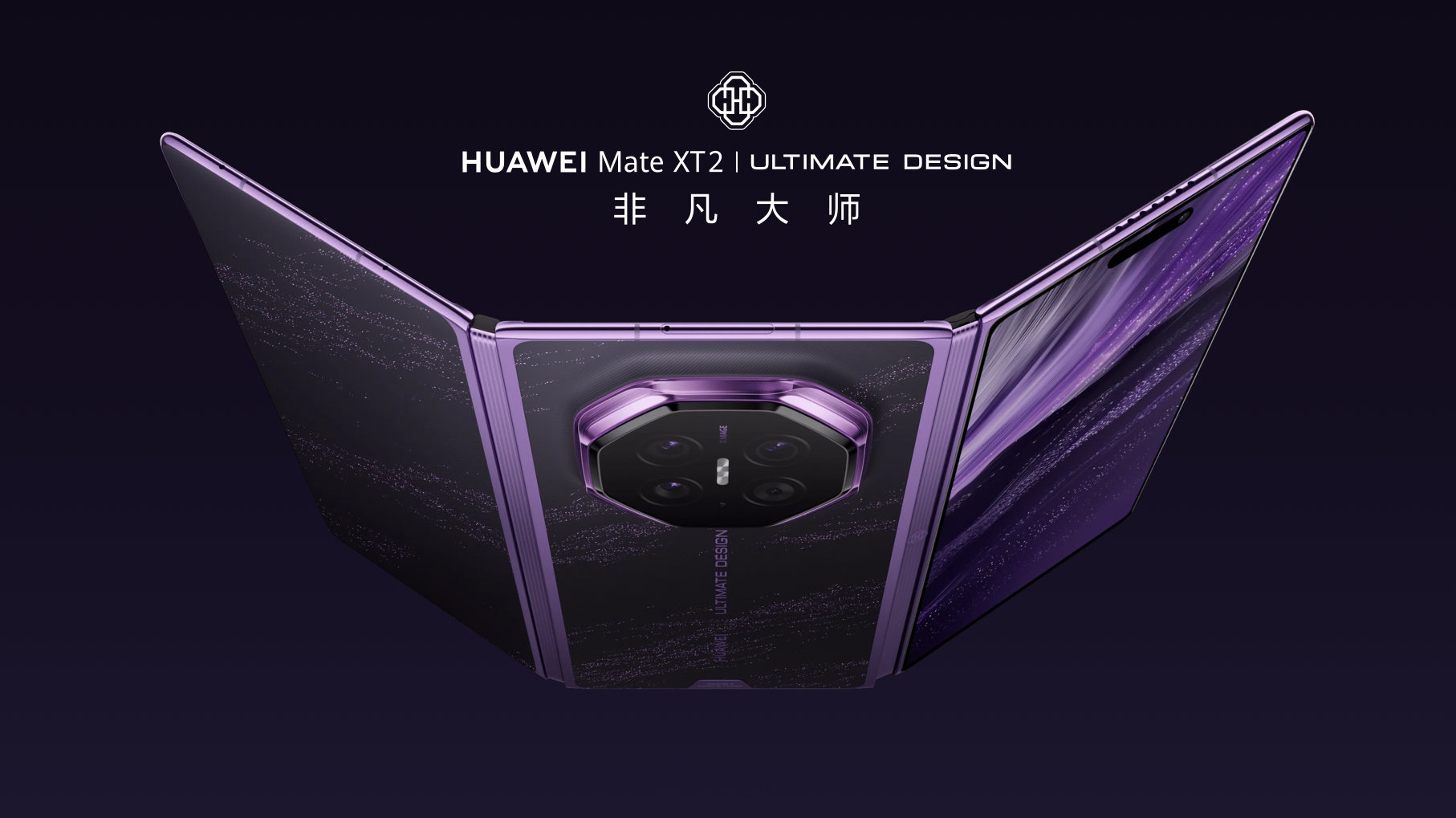
The most obvious change is that the Mate XT 2 now folds inward. The first two Mate XT models wrapped the flexible display around the outside in an “S” fold, which left the screen exposed when shut. This one tucks the big panel safely inside and puts a separate 6.5-inch cover screen on the outside — the same philosophy Samsung introduced on the Galaxy Z TriFold, and the same one that powers our Xiaomi 18 Fold just yesterday.
Shut it and you’re holding a 157.2 x 77mm slab that’s 12.3mm thick and weighs about 299g. That’s heavier than most mainstream foldables of 2026 — the Galaxy Z Fold8, for reference, is a feather by comparison. You will notice it in a jeans pocket. Open it up and it spans a full 219.2mm wide, while the three folded sections thin out to between 3.5mm and 4.0mm. Huawei offers it in Dark Black, Pure White and Jin Purple, all in that unmistakable Ultimate Design finish.
Around the edges it carries an unusual dual rating: IP58 and IP59 for dust and water. Combined, they’re a strong durability story for a device this delicate-looking. Still, a two-hinge tri-fold is fragile by definition, and 299g of it bouncing around a bag is a trained-fingers proposition.
Display
The cover screen is a 6.5-inch OLED with a 2442 x 1140 resolution, an adaptive 1-120Hz LTPO refresh rate and 1,440Hz PWM dimming for smoother low-light viewing. Open it up and the main canvas stretches to a 10.2-inch 2232 x 3184 folding OLED — a proper mini-tablet when you need it, and just a big phone when you don’t.
Huawei also sells an optional Privacy Screen version for about CNY 1,000 extra. It uses an independent dual-pixel design that can narrow the viewing angle at the hardware level, so a stranger sitting beside you on the bus sees a dimmed blur while you still read it dead-on — and you can switch it on per-app. It’s the same trick Samsung put on the Galaxy S26 Ultra, and it’s genuinely useful for banking or messages in public. Just know it won’t hide your screen from someone standing behind you, and for now it’s only on the Chinese-market units.
Performance
Under the hood is the new Kirin 9050 Pro, and this is where Huawei’s engineering story gets interesting. It pairs a LinxiCore CPU with a Maleoon GPU and a Da Vinci architecture NPU, layering 1 prime core, 2 performance cores, 4 efficiency cores and 2 little cores. The GPU even does hardware-accelerated real-time ray tracing at up to 50 million rays, plus on-device processing for large AI models.
The bigger deal is the chip’s design philosophy. Huawei built the Kirin 9050 Pro around its new Tau Scaling Law. Instead of relying only on shrinking the process node, the approach attacks signal delays inside the chip — a technique Huawei calls LogicFolding that packs more transistors into a smaller area. The company claims that can boost transistor density by 53.5%, improve performance-core power efficiency by 41% and push maximum clock speeds up 12.7%. For context, Huawei says the 9050 Pro is the most powerful Kirin it has ever made, around 42% faster than the previous Mate XT.
Standard memory is 16GB of RAM with storage from 256GB all the way up to 2TB. That’s comfortably flagship-spec. But this is a launch-day assessment: there are no independent benchmarks or sustained thermal tests from reviewers yet, so the “42% faster” figure is Huawei’s claim, not a tested one. Given how quickly this niche moves, I’d wait for the first batch of hands-on testing before taking it as gospel.
Camera
Foldables usually compromise on cameras, but this one is a genuine flagship shooter. The main camera is a 50MP 1/1.28-inch RYYB sensor with optical image stabilization and a variable aperture that steps from f/1.49 down to f/4.0 — the kind of hardware-level light control you mostly see on Huawei’s Pura flagships. It’s joined by a 40MP f/2.2 RYYB ultra-wide and a 50MP f/2.2 RYYB periscope telephoto with OIS, offering 3.5x optical zoom, 7x optical-quality hybrid zoom and up to 100x digital. A third-generation Red Maple colour camera handles tone reproduction.
That’s a big step up from the previous Mate XT, which made do with a 12MP ultrawide and a 12MP periscope. Even so, 3.5x optical is a little conservative next to some rivals that push 5x, and I can’t vouch for low-light quality until real photos surface. On paper, though, this is as good as a camera setup gets on any foldable in 2026. Both the inner and cover screens get 8MP f/2.4 ultra-wide selfie cameras.
Battery & Charging
You get a 5,600mAh battery with 66W wired SuperCharge and 50W wireless charging. It’s the same capacity as the original 2024 Mate XT, which is a little disappointing given the inner screen now runs a faster 120Hz in the privacy variant and the whole package asks more of the panel. On a 10.2-inch screen that chews power, 66W wired is fine but no longer class-leading — plenty of mid-range phones charge faster now.
What the Mate XT 2 does have that almost nothing else does is satellite calling plus two-way BeiDou satellite messaging, so it’s genuinely useful off the grid. Real-world endurance is unverified at launch, so treat “all-day” as a hope, not a finding.
Software
Here’s the honest heart of this review. The Mate XT 2 ships in China with HarmonyOS 7.0, built around Huawei’s AppGallery and its own ecosystem. There is no Google Play Services on board, which means the apps virtually every Filipino depends on — GCash, Maya, most banking apps, Google Maps and the rest of the Google suite — will not run out of the box. We flagged exactly this on our nova 16s and Pura 90s Pro Max reviews, and it’s the single biggest caveat for anyone in the Philippines. That HarmonyOS 7.0 build also does the multitasking well — you can run three apps side by side on that 10.2-inch canvas — but the app gap is what will stop most local buyers cold.
Pros and Cons
| Pros | Cons |
|---|---|
| Genuinely useful 10.2″ tri-fold canvas that becomes a mini-tablet | No Google Play Services — GCash, Maya and banking apps won’t run out of the box |
| Flagship in-house Kirin 9050 Pro with a 42% faster claim over the last generation | China-only at launch, with no Philippine availability or pricing confirmed |
| Serious camera hardware for a foldable: 50MP variable-aperture main plus a 50MP periscope | Roughly 299g and 12.3mm folded — a heavy slab in the pocket |
| Privacy Screen option stops side glances at the hardware level | Starts at CNY 19,999 (about ₱160,000), easily laptop or second-hand-car money |
| 5,600mAh battery, 66W wired, 50W wireless and satellite calling | No independent benchmarks or real-world battery tests yet at launch |
| Dual IP58 + IP59 dust and water resistance | 3.5x optical zoom is modest next to some rivals’ 5x+ |
| Premium Ultimate Design build in Dark Black, Pure White and Jin Purple | Same 5,600mAh battery as the 2024 original despite a hungrier screen |
Should You Buy This?
Buy it if
- You want the most extreme, most capable folding screen money can buy, full stop.
- You already live inside Huawei’s AppGallery and HarmonyOS ecosystem and don’t miss Google.
- Satellite calling, two-way BeiDou messaging and a hardware privacy screen genuinely matter to you.
- You can afford to import one from China and price isn’t a real constraint.
Skip it if
- You rely on Google apps — GCash, Maya or your bank. This phone simply will not run them out of the box.
- You’re in the Philippines and want warranty, service and local pricing. None of that exists yet.
- You need a practical everyday phone that can survive a drop. A 299g two-hinge tri-fold is a fragile slab.
- You’re on anything like a normal phone budget. Far cheaper foldables cover almost everything this does.
Final Verdict
So who is the Huawei Mate XT 2 for? Honestly, it’s for a very small crowd: people with serious money who want the most outrageous thing in their pocket and are content to live entirely inside Huawei’s ecosystem. It’s a statement of engineering swagger — a tri-fold folded the smart way, running a chip Huawei built under its own Tau Scaling Law philosophy rather than anyone’s off-the-shelf silicon. As a showcase of what Chinese chipmaking is doing, it’s genuinely impressive.
For almost everyone in the Philippines, though, the arithmetic doesn’t hold up. At a converted ₱160,000-plus starting price, it costs more than flagship foldables that run every app you actually need — it’s well clear of the ₱109,990 Galaxy Z Fold8 and miles past value picks like the ₱79,999 Pura 90s Pro Max — and you can’t run your money apps on it, with no local warranty to fall back on. That’s a brutal combination even before you consider the weight.
If you’re the collector who buys the millionaire-tier toy for the story, this is one of the most interesting phones of the year. If you want a phone, Huawei has cheaper, more practical foldables. The Mate XT 2 is a marvel you can’t live with — and for 2026, that’s exactly where it lands for the open-market crowd. It doesn’t crack our Top 10 Phones list for the same reason a race car isn’t your daily driver: brilliant, unmissable, and utterly the wrong tool for most days.