
Isuzu has quietly done something big for the Philippine electric vehicle scene, and most people missed it. The Department of Energy just added the Isuzu N-Series EV to its list of recognized electric vehicles. That’s the same pre-launch signal we’ve watched with the Kia EV3 and the Jaecoo J8 PHEV — when a brand officially lists a truck on the DOE roster, it’s usually gearing up for a local launch.
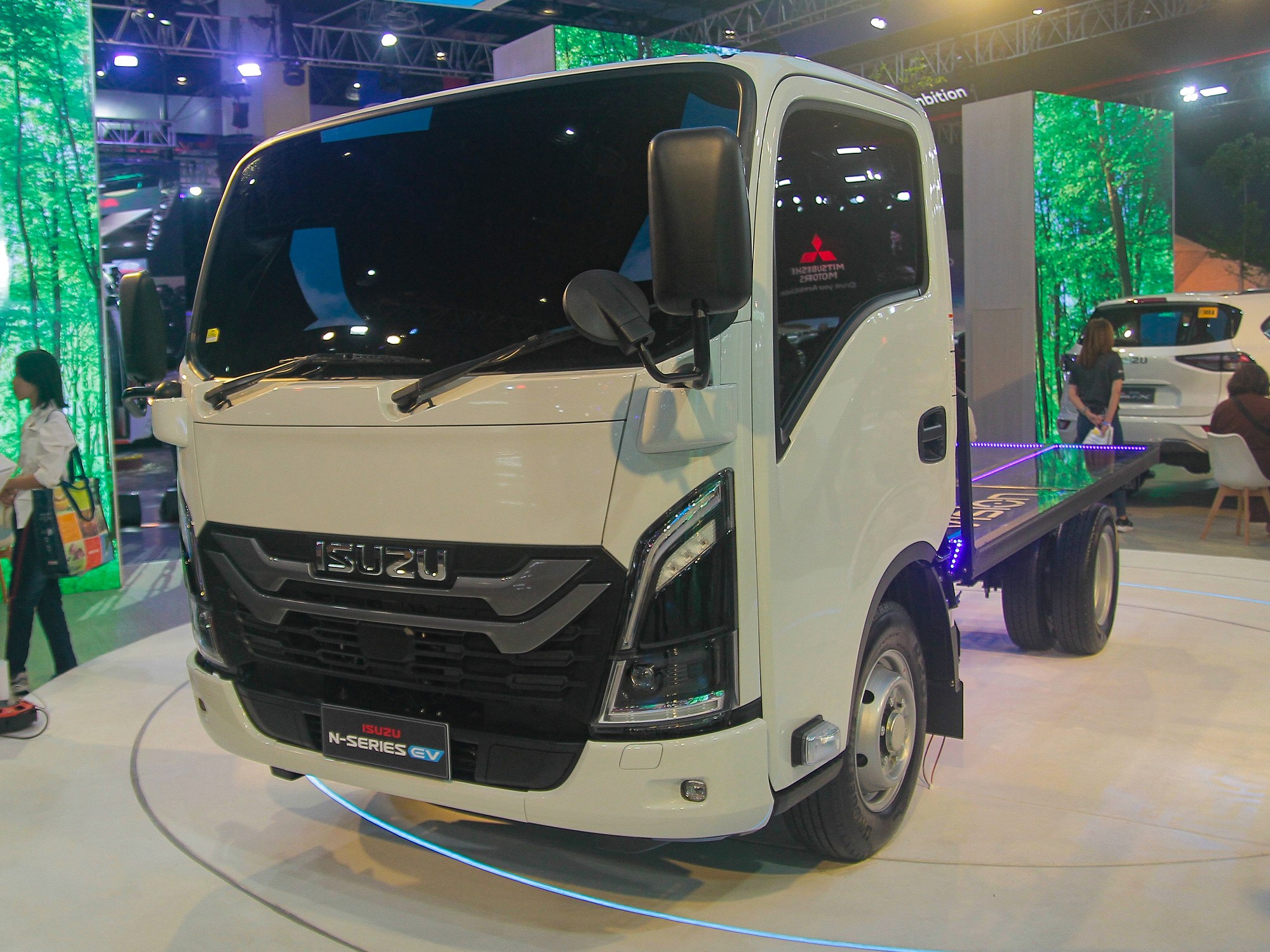

And this is Isuzu, the name behind the Elf, the QLF, and half the delivery trucks you see on EDSA. If the country’s diesel-workhorse brand goes electric, that’s a big deal for fleet owners. Here’s what we know.
What Is the Isuzu N-Series EV?
The N-Series is Isuzu’s light-duty commercial truck family — what the Japanese market calls the Elf. It’s been hauling goods in the Philippines for decades as a diesel runner. Now there’s an all-electric version, and the DOE paperwork confirms the specific cab-and-chassis variant headed our way.
This isn’t a concept anymore either. Isuzu showed the N-Series EV Concept at PIMS back in 2024 with a modest 40 kWh pack. The version on the DOE list is the real production truck, and it’s a significant step up in capability.
Isuzu N-Series EV key specs (DOE PH listing)
| Motor | Single electric, 167 kW (227 PS) / 420 Nm |
| Battery | 100 kWh lithium iron phosphate (LFP, CATL) |
| Range | Up to 299 km |
| Charging | CCS2 DC fast charging |
| Body | Cab & chassis, 3-seater |
| Dimensions | 5,820 x 2,020 x 2,275 mm |
| Wheelbase | 3,360 mm |
| Gross vehicle weight | 4,495 kg |
| Model year | 2026 |
AutoIndustriya flagged the listing on August 27, 2026. The key detail is that big 100 kWh battery with a CCS2 port. That’s a fast-charge-capable truck, not a short-range neighborhood delivery toy. LFP chemistry means it’s also more heat-tolerant — relevant when you’re running a truck all day under the Philippine sun.
Price in the Philippines: no SRP yet
Isuzu Philippines has not announced a local price or a launch date. That’s expected at this stage — the DOE listing is a strong signal that one is coming, but the sticker is still a question mark.
Here’s what we can anchor an estimate on. Isuzu’s international pricing gives us a base: the Japanese-market Elf EV starts around ¥6.48 million (roughly $47,000). And locally, the Foton Tornado EV — a comparable electric truck — sits around ₱3.6 million. Given the N-Series is a lighter-duty rig than that Foton, a realistic Philippine estimate lands in the ₱3.2 to ₱4.0 million range.
| Philippines (est.) | ₱3.2M – ₱4.0M |
| US (est.) | $51,900 – $64,800 |
| India (est.) | Rs 49.6L – 61.9L |
Estimate based on ~61.7 PHP/USD and ~95.5 INR/USD, anchored on the Foton Tornado EV (₱3.6M) and Isuzu’s Japanese Elf EV starting price. Treat these as ballpark figures, not official SRP.
What others are saying
AutoIndustriya’s Marcus De Guzman framed it as the natural next step after Isuzu’s PIMS concept: with other light-duty brands going electric, Isuzu finally catching up makes sense. The listing, he notes, suggests the truck “has already been earmarked for the Philippine market.”
Internationally, reviews of the Elf EV family have been positive about the fundamentals. Motor1 highlighted that the seventh-generation Elf brought a raft of new safety features — pre-collision braking, blind-spot monitoring, and adaptive cruise control that were firsts for a Japanese light truck. Isuzu’s own US materials for the bigger NRR EV emphasize how the electric drivetrain replaces engine braking with true regenerative braking, cutting wear on the service brakes.
The consistent theme from global reviews: electric trucks aren’t just cleaner, they’re actually nicer to drive. No gear-shifting in stop-and-go, instant torque from a standstill, and far less noise for drivers who spend eight hours behind the wheel.
Is the N-Series EV right for Filipino driving?
City driving
This is where an electric truck shines. Stop-and-go traffic on EDSA, C5, and the inner streets of Makati kills diesel engines with idling and shifting fatigue. An EV just sips energy at a standstill and pulls away smoothly. For a delivery fleet doing many short trips a day, the 299 km range is more than enough — you’d recharge overnight and start full again.
Long-distance travel
This is the honest caveat. 299 km is fine for Metro Manila routes and short provincial hops, but a full Manila-to-Baguio run (roughly 250 km one way) leaves little margin, especially loaded. You’d want a CCS2 fast-charging stop for comfort. As the charging network grows — remember the battery-charging infrastructure story — intercity electric trucks become more practical. For now, this is a city-and-nearby workhorse, not a long-haul hauler.
Flooded situations
Flooding is a real worry for Philippine commercial vehicles. The good news: an EV has no air intake, so it can’t hydrolock the way a diesel can. The bad news: the battery sits low, and without a published IP rating for this specific variant, you should respect an old rule of thumb — don’t wade deeper than the bottom of the doors. The jacked-up cab gives reasonable clearance, but I’d still avoid deep floodwater with a heavy electric truck.
High temperatures
The LFP battery is the right call here. Lithium iron phosphate is more thermally stable than NMC chemistries, which matters when you’re running a truck through a 36°C Metro Manila afternoon. It won’t catch fire as easily under stress, and it handles sustained heat better. For a commercial vehicle that works hard all day, that’s a real advantage.
Should fleet owners get excited?
Short version: yes, but with patience. The DOE listing is one of the strongest signals we get that a launch is near — it’s the same checklist that preceded the Kia EV3’s arrival. But Isuzu is famously cautious, and the truck doesn’t have a local price or date yet.
For a family business or a logistics operator, an electric work truck makes serious economic sense once the numbers work — no fuel cost, lower maintenance, and instant torque for stop-and-go routes. The local EV scene is growing fast enough that electric commercial vehicles are becoming a realistic option, not a novelty.
I’ll be watching for the official Isuzu announcement. If the N-Series EV lands here at a competitive price, it could quietly become one of the most important EVs in the country — and it won’t be a car most people think about when they say “EV.” Sometimes the biggest electric revolution in the Philippines is happening in the delivery lane, not the fast lane.