
Motorola launched the Moto G Max in global markets back in June, and it was a perfectly normal mid-range phone: a 6.8-inch screen, a 200MP main camera, and a 5,200mAh battery. Then the company turned around and announced the Moto G Max for India with a completely different spec sheet — a Snapdragon 6s Gen 4 chipset, a 50MP camera, and a massive 7,000mAh silicon-carbon battery. Same name, different phone, and it lands in India on August 14.
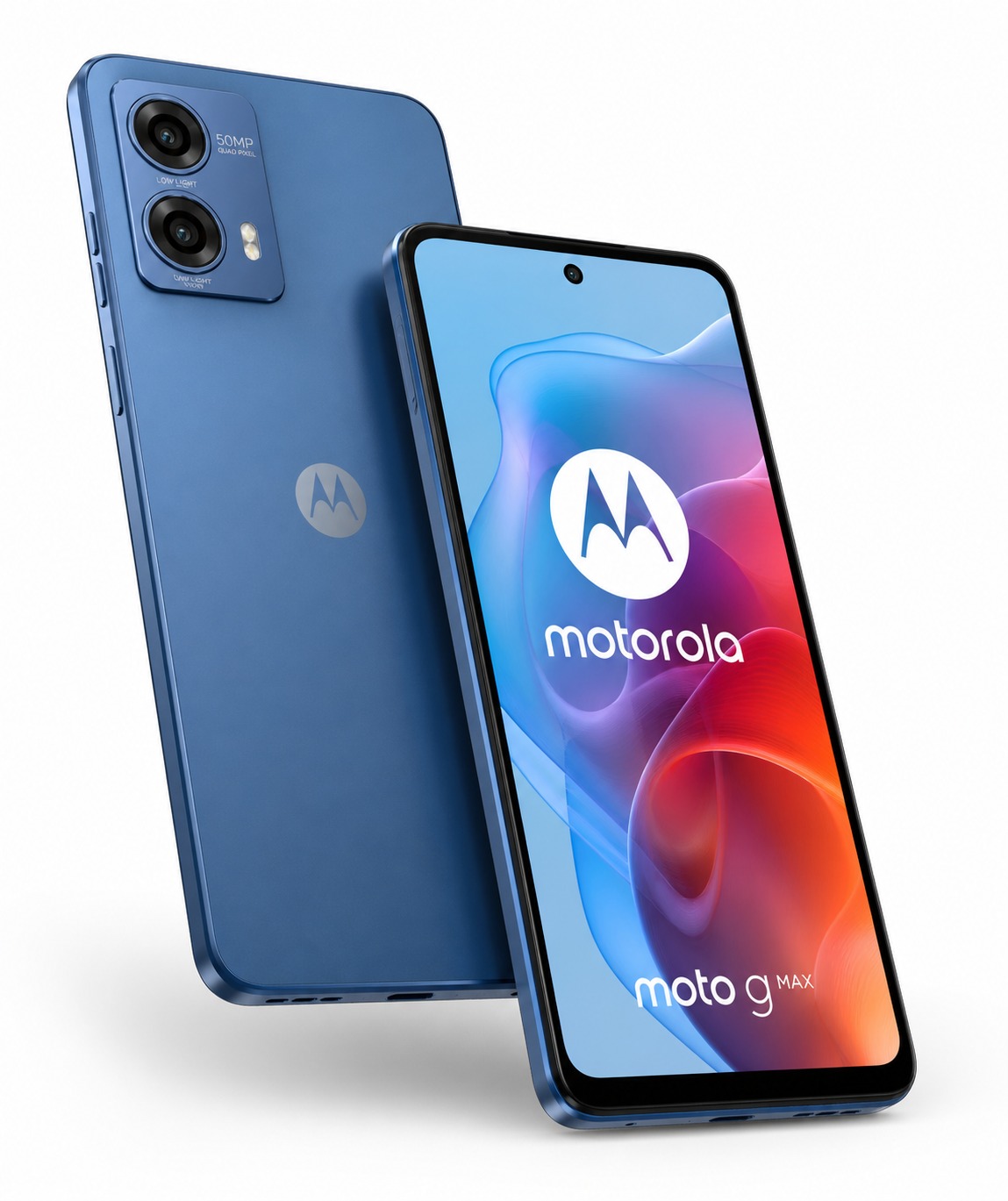
That naming mess is the first thing worth understanding about this device, because most of what you’ll read about the “Moto G Max” online describes the global version. This review is about the India model — the one with the battery-first pitch — and what it actually brings to the table.
Design & Build Quality
Motorola’s teasing shows a phone with a satin finish, a flat frame, and a prominent vertically-stacked camera module. It’s a clean, utilitarian look — the G-series has always played it safe here, and the G Max keeps that streak alive. The Pantone-curated color options are Alaskan Blue, Malaga, and Stargazer, which means the “blue” in every Flipkart teaser is actually a soft, desaturated tone rather than a loud one.
What stands out is durability. The India G Max carries Corning Gorilla Glass Ceramic on the front, an IP64 rating for dust and splash resistance, and MIL-STD 810H certification for shock and temperature resistance. That combination is rare in this segment — most rivals give you one of those, not all three. For a phone built around being carried everywhere and rarely charged, the toughness actually makes sense.
Around the edges you get a side-mounted fingerprint sensor, a 3.5mm headphone jack, and stereo speakers with Dolby Atmos. No wireless charging, no surprises, and no official weight figure yet — the similarly-built Moto G57 Power tips the scales at 210g, so expect something in that ballpark once Motorola publishes final dimensions.
Display
The Moto G Max ships with a 6.72-inch FHD+ LCD running at 120Hz, with up to 1,050 nits of brightness in high-brightness mode. That last number is the marketing figure, mind you — it’s a local-peak measurement, not sustained full-screen brightness. Still, it’s a bright panel by LCD standards, and in direct sunlight it should stay readable where a typical 500-nit budget panel washes out.
It’s an LCD, not an AMOLED, so you give up per-pixel blacks and always-on display finesse. What you gain is the peace of mind that comes with a panel that doesn’t suffer burn-in and costs less to replace. At 120Hz, scrolling and app transitions feel smooth, and the FHD+ resolution keeps text crisp — this is a display that does the job without trying to impress.
The genuinely interesting feature here is Water Touch 2.0, Motorola’s wet-touch technology. If you’ve ever tried to reply to a message with wet fingers after a downpour in EDSA traffic, you know exactly why this matters. It’s a small quality-of-life feature that says the phone was designed for real-world conditions, and it’s one of the reasons this device feels more thought-out than its spec sheet suggests. If AMOLED is non-negotiable, Motorola’s own Edge 70 Pro is the brand’s curved-OLED alternative — a higher price tier, but proof the company saves its best screens for the Edge line.
Performance
Powering the G Max is the Snapdragon 6s Gen 4, a 4nm chipset with two Cortex-A78 performance cores, six Cortex-A55 efficiency cores, and an Adreno 710 GPU. It’s the same silicon that shipped in the Moto G57 Power late last year, and by now its performance profile is well documented. In AnTuTu 11, it lands around 805,000 to 810,000 points, and on Geekbench 6 it scores roughly 1,010 single-core and 2,880 multi-core.
How does that translate to daily life? It’s roughly 30% faster than the older Snapdragon 6s Gen 3, and within striking distance of the full Snapdragon 6 Gen 4 — the gap is mostly in GPU-heavy workloads. In practice, that means smooth app switching, comfortable multitasking, and 60fps in competitive titles at medium-to-high settings. Heavier games like Genshin Impact will ask you to dial settings down, which is expected at this price tier. Thermal management should be fine for a mid-ranger — the 6s Gen 4 doesn’t generate the heat of flagship silicon.
The catch is memory. The confirmed configuration is 6GB of LPDDR5X RAM with 256GB of UFS 3.1 storage, and Motorola leans on its RAM Boost virtual-memory feature to stretch that up to 18GB of combined RAM. Virtual RAM helps with app retention, but it’s not the same as physical memory — if you’re a heavy multitasker who keeps a dozen apps alive, 6GB is going to feel tight in 2026, and GSMArena readers were already asking for an 8GB variant. Storage is 256GB in the confirmed config, with no word yet on a microSD slot.
Camera
On the back sits a 50MP Sony LYTIA 600 main sensor joined by an 8MP ultrawide. The front gets a 32MP selfie camera with AI-based enhancement. It’s a sensible dual-camera setup — no useless macro or depth sensors padding the spec sheet, just the two lenses you’d actually use.
This exact camera configuration was reviewed on the Moto G57 Power, and the consensus there is worth repeating: daylight shots come out natural with good color, the ultrawide is serviceable but softer at the edges, and the front camera is average — fine for video calls, not a selfie flagship. Low light is where budget sensors struggle, and the G Max’s lack of optical image stabilization (Motorola lists only electronic stabilization) means night shots will rely heavily on processing. Expect the same honest mid-range performance here, with no telephoto lens to zoom with — the 50MP sensor’s in-sensor crop is your only zoom option.
Battery & Charging
Here’s the headline: a 7,000mAh silicon-carbon battery rated for 1,000 recharge cycles, with Motorola claiming up to three days of battery life. Claims are claims, but the G57 Power’s identical battery formula was tested by multiple outlets, and the results were consistently impressive — 24 to 25-hour usage cycles with over 40% remaining, around 9 hours of screen-on time in a day, and easy two-day endurance under moderate use. The G Max should land in that same territory.
The silicon-carbon chemistry is the part worth celebrating. It packs more capacity into the same footprint as a standard lithium cell, and the 1,000-cycle rating means the battery should still hold a respectable charge after three years of daily use — a genuine longevity feature, not marketing fluff.
Charging, though, is the elephant in the room. 30W wired is the slowest charging in the big-battery class. The G57 Power’s real-world tests showed 20-to-100 percent taking roughly 73 minutes with its bundled 33W adapter (some reviewers clocked closer to two hours), and you should expect similar patience-testing numbers here. Meanwhile, the Redmi 17 5G we reviewed this morning does 45W, the Realme 16x 5G does 45W, and the Realme P4 charges its 7,000mAh cell at 80W. The G Max is a two-day phone that takes its sweet time refilling — if you habitually top up at odd hours, that’s a real trade-off. And if you want Motorola’s true endurance flagship, the Edge 70 Max goes further with 7,100mAh and Qi2.2 wireless charging — a different league in price, but the family’s battery king.
Software
The G Max runs Android 16 out of the box with Motorola’s near-stock interface — the cleanest, least bloated Android experience in the budget-to-midrange space, full stop. No duplicate app stores, no aggressive ads, just Google’s Android with a few tasteful Moto gestures. If you’re coming from a heavily-skinned Xiaomi or Realme device, the difference is immediately noticeable.
The uncomfortable part is updates. Motorola promises two OS upgrades and three years of security patches — the same commitment it made on the G57 Power. In 2026, that’s the weakest policy in the segment. Samsung’s Galaxy F70 Pro promises six years of updates, Xiaomi and OnePlus offer four or five, and even budget players have started matching them. A 7,000mAh battery suggests a phone built to last years; a two-year OS promise says otherwise. If long-term software support matters to you, this is the G Max’s biggest compromise.
Pros and Cons
| Pros | Cons |
|---|---|
| 7,000mAh silicon-carbon battery with genuine 2-3 day endurance | 30W charging is the slowest in the big-battery class |
| 1,000-cycle battery rating — built to last | Only 6GB RAM in the confirmed config |
| Clean near-stock Android 16 with zero bloatware | LCD panel instead of AMOLED |
| IP64 + MIL-STD 810H + Gorilla Glass Ceramic durability | Just 2 OS upgrades and 3 years of security patches |
| Water Touch 2.0 wet-touch display works in the rain | No OIS, no telephoto lens on the camera |
| 3.5mm headphone jack and Dolby Atmos stereo speakers | “Max” name collides with a completely different global phone |
Should You Buy This?
Buy it if
- Battery life is your top priority. A 7,000mAh cell that realistically lasts two days under normal use — this is the kind of phone you charge every other night.
- You’re hard on your devices. IP64, MIL-STD 810H, and ceramic glass protection make this one of the toughest mid-rangers around.
- You use your phone in the rain or near water. Water Touch 2.0 is rare and genuinely useful for commuters.
- You hate bloatware. Near-stock Android with reliable updates-for-now beats a polished but ad-infested skin.
Skip it if
- You need fast charging. 30W on a 7,000mAh battery means planning your top-ups. The Redmi 17 5G or Realme 16x 5G charge faster on similar batteries.
- You keep phones for more than three years. The two-OS-upgrade policy will leave you stranded on Android 18 while rivals push version five or six.
- You want a camera zoom. There’s no telephoto and no OIS — this is a main-camera phone through and through.
- You’re outside India. No international availability has been announced, and the name collision with the global Moto G Max makes buying the wrong variant a genuine risk.
Final Verdict
The Moto G Max (India) is best understood as the G57 Power formula refined: the same 7,000mAh battery and Snapdragon 6s Gen 4 silicon, wrapped in a tougher, better-finished body with Gorilla Glass Ceramic, MIL-STD 810H, and a brighter display. If that formula is what you want — and the real-world battery results on the G57 Power suggest it’s excellent — the G Max is a worthy evolution.
The verdict hinges on price, which Motorola hasn’t announced yet. Tipsters put it around ₹30,000 (roughly ₱19,000), which would be nearly double what the G57 Power costs for a very similar spec sheet — a hard sell against 45W rivals with better update promises. Around the ₹18,000-20,000 mark, though, this becomes a compelling battery-first choice with genuinely unique durability features.
Who is this phone for? The person who charges every other day, drops their phone regularly, and works in a place where it rains without warning. Motorola just needs to price it like the sensible mid-ranger it is — and for everyone else, wait for the August 14 launch before making up your mind. If you’re still weighing options across budgets, our roundup of the best phones for every price range is a good place to start.