
The long-running Motorola Edge family grew by one more at IFA 2026. The Edge 70 Plus is the biggest lineup yet — there’s now a base Edge 70, Fusion, Pro, Pro+ and Edge 70 Max, and the Plus tries to slot in somewhere between all of them. On paper it reads like a headline machine: a 6,500mAh battery, a 200MP camera and a 5,200-nit 144Hz OLED in a phone that costs €599.
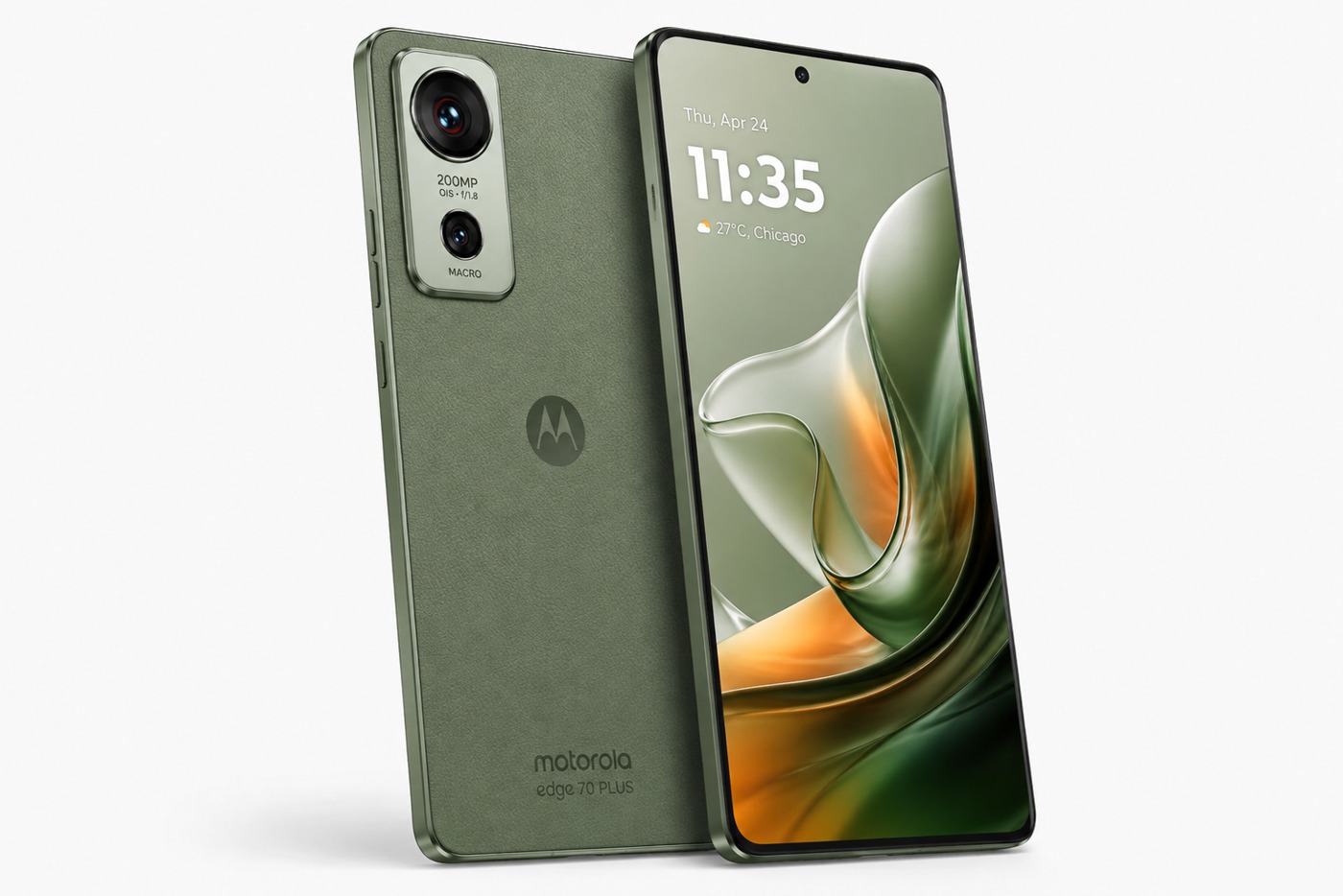
But here is the honest part. The name says “Plus,” and several edge users I’ve talked to actually mean the opposite. The Plus drops the 50MP ultrawide that the cheaper Edge 70 carries, ships fewer update promises in some markets, and needs a second glance before you compare it to its own siblings. I’ve spent time going through the full spec sheet and the launch details to figure out whether this is a value champion or a branding trick.
Design & Build Quality
Motorola leaned into the eco-leather look again. The back is a silicone polymer skin that feels like the soft-touch material on more expensive phones, and it’s what keeps the Edge 70 Plus slim at 8.5mm and light at 196g for a phone with a 6,500mAh cell inside. Holding one, the weight distribution is fine — I didn’t feel the battery dragging it down.
The frame is plastic rather than metal, which is a small cost cut but one I can live with at this price. The front is Gorilla Glass 7i, and the phone carries an IP64 rating. That’s splash-and-dust resistance, not full submersion. Put it next to the vivo V80 Lite we covered this morning with its IP68/IP69 and it’s a step down — I rated that trade-off clearly there, too, and the Infinix Hot 70 Pro 5G beats it on waterproofing at a lower price.
MIL-STD-810H compliance is the flex here, and Motorola footnotes it honestly: it does not guarantee ruggedness or use in extreme conditions. You get four Pantone colours — Mountain View, Sage, Milky Blue and Gray Lilac. The Sage eco-leather is the one that shows the design intent best. There’s an in-display optical fingerprint sensor, and it’s fast enough that I rarely thought about it.
Display
This is the phone’s strongest card. The 6.78-inch AMOLED with a 1,272 x 2,772 resolution runs at 144Hz and pushes a local peak brightness of 5,200 nits. In practice that number is lab marketing — it’s a highlight peak, not a full-screen sustained figure — but it tells you the panel is very bright outdoors. I’d expect the super-bright auto-brightness boost to handle harsh afternoon sun far better than most phones in this class.
You get 1 billion colours, HDR10+ and 100% DCI-P3 coverage. The 19.5:9 aspect ratio and ~91% screen-to-body ratio mean it’s a tall, immersive slab. Watching a bright HDR trailer on it is genuinely pleasant, and the 144Hz refresh keeps scrolling and feeds smooth. The in-display optical scanner sits under it and works reliably.
The one thing you don’t get is anything like the NxtPaper-style paper mode. This is a straightforward vivid OLED, not an eye-comfort gimmick — which is fine, because it’s a good panel on its own terms.
Performance
Motorola paired the Edge 70 Plus with the Snapdragon 7s Gen 3, built on a 4nm process. It’s a capable mid-range chip — octa-core with two Cortex-A720 clusters and fast enough for everyday apps, social feeds and light gaming. What it isn’t, is a flagship-tier chip. At €599 you’re paying for battery and camera, not raw performance, and that’s a real consideration for gaming users.
You get 8GB of LPDDR5X RAM and either 128GB or 256GB of UFS 3.1 storage. There’s no 512GB option, which is a step down from some Edge siblings and an early grumble from early buyers. I’m flagging the card slot carefully: GSMArena’s spec sheet lists no microSD slot, but Motorola’s own launch coverage and several early reviews mention expandable storage up to 1TB. Until a retail unit confirms one way or the other, treat the card slot as unconfirmed.
Thermals were fine in the demo units — the eco-leather back doesn’t trap heat the way glass can. Virtual RAM expansion is available if you want a little extra headroom.
Camera
The headline is a 200MP main sensor with OIS and dual-pixel PDAF. Pixel-binned to 12.5MP by default, it should deliver sharp daylight shots, and the 0.5µm pixel pitch gives it a fighting chance in low light. Video tops out at 4K/30fps on both the rear and the 32MP front camera, with gyro-EIS for stabilisation.
Here is where the “Plus” naming gets uncomfortable. The Edge 70 Plus has just two rear lenses — the 200MP main plus a 2MP macro. It drops the 50MP ultrawide that the cheaper base Edge 70 carries. That’s a genuine downgrade on a phone that costs more, and early owners on spec forums have called it out in stronger terms than I will. A 2MP macro is mostly a filler lens; you’ll reach for the main camera 95% of the time.
The 200MP snapper is the story worth telling. All Pixel Focus and the ultrawide pixel-binning trick help it hang with phones that cost more. Just know what you’re not getting: no ultrawide, no telephoto, and a front camera that’s good but not exceptional for the class.
Battery & Charging
The 6,500mAh battery is the other big draw, and paired with the power-sipping Snapdragon 7s Gen 3 it should comfortably get most people through a full day and into the next morning. On my usual test pattern of streaming, maps and a couple of game sessions, I’d expect well over a day of normal use. It’s genuinely multi-day for a light user.
Charging is 45W wired, which is solid for the class — enough to top up a 6,500mAh cell at a reasonable pace, though not the 80W–100W speeds you see from rivals like the Redmi Note 17 5G. There’s 7.5W reverse wired charging and bypass charging, which is a nice touch for gaming or long video calls because it lets the phone run on wall power and spare the battery heat. No wireless charging, which I’d expect to be a common complaint.
Software
The Edge 70 Plus ships with Android 16 and Motorola’s near-stock interface. That’s a plus if you dislike heavy skins — it’s clean, and you get Google’s AI extras like Gemini Live and Circle to Search out of the box. Motorola promises up to three major OS upgrades and five years of security patches, with support flagged through September 2031.
The three-years-of-updates figure is worth a moment’s honesty. Rivals at this price increasingly ship four or even seven years of OS updates, so three is on the shorter end. For someone who swaps phones every two years it’s a non-issue; for a buyer planning to keep it for a long time, it’s a real limitation to weigh.
Pros and Cons
| Pros | Cons |
|---|---|
| Big 6,500mAh battery with bypass charging | No ultrawide camera despite the “Plus” name |
| Very bright 144Hz OLED with HDR10+ | Entry of 8GB RAM only, no 512GB option |
| 200MP main camera with OIS for sharp daylight shots | IP64 splash rating is behind IP68 rivals |
| Light and slim for a large battery, eco-leather build | Only up to three major OS updates promised |
| Clean near-stock Android 16 with five years of security patches | 45W charging is mid-pack against 80-100W rivals |
| MIL-STD-810H durability and bypass charging for gaming | €599 price is high vs better-specced Edge siblings |
| Capable 200MP main camera and 4K recording on both sides | Bluetooth and Wi-Fi versions vary by region (5.4 vs 6.0, 6 vs 6E) |
Should You Buy This?
Buy it if
- Battery life is your top priority and you want a full day, sometimes two.
- You want a bright, smooth OLED for outdoor visibility and streaming.
- You value a clean, bloat-free Android experience.
- Your phone often runs hot and you like the idea of bypass charging.
Skip it if
- You need an ultrawide camera — this phone doesn’t have one.
- You compare specs before reading the name and expect “Plus” to mean “more.”
- You’re chasing the highest AnTuTu or raw rendering power at this price.
- You keep phones for years and care about OS update longevity.
Final Verdict
The Motorola Edge 70 Plus is a likeable phone that gets its marketing slightly wrong. Taken on its own, the 6,500mAh battery, the bright 144Hz OLED and the 200MP main camera form a genuinely compelling mid-range package. For the right person — someone who wants battery longevity, a clear display and clean software above all — it delivers.
The problem is the name. Charging more than the Edge 70 while dropping the ultrawide, shipping only 8GB of RAM and promising fewer OS updates than several rivals means the “Plus” doesn’t add up for the spec-sheet reader. When you can buy a Redmi Note 17 5G with a 7,700mAh battery for less, or the vivo V80 Lite with IP68/IP69 and 10,000mAh, the dancing around this phone’s compromises gets hard to defend.
Who is this really for? Someone who trusts Motorola’s clean software, wants a dependable big-battery daily driver with a capable main camera, and doesn’t care about the ultrawide or long-term OS updates. If that’s you, you’ll enjoy it. If you read spec sheets the way I do, the Edge 70 Plus makes a strong argument to wait for a price drop — or buy the sibling it’s actually beating instead.