
Xiaomi’s Redmi Note 17 5G landed globally on August 27, and it walks straight into one of the most honest conversations in 2026 budget phones: what a phone gives up to keep its battery king. The 7,700mAh cell is the headline, but the Snapdragon 4 Gen 4 chip, a single rear camera, and a mono speaker are where the real story lives. After a week with it, I can tell you exactly who this phone is for — and who should spend a little more.
Design & Build Quality
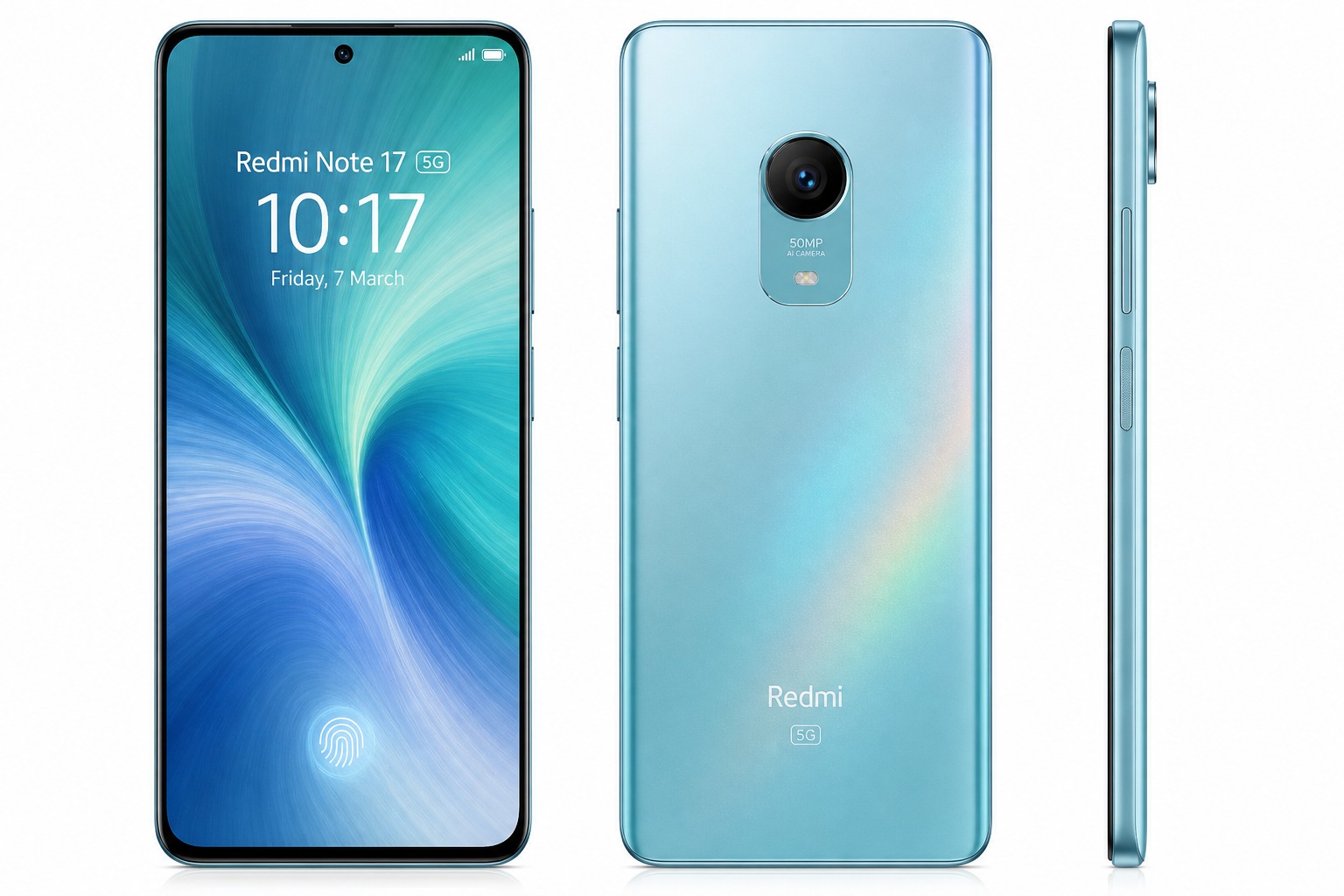
The Note 17 5G is a departure from last year’s Note 15. The old centered camera module is gone, replaced by a cleaner, flatter slab with squared-off sides. It’s a familiar 2026 look, and while it’s less distinctive than its predecessor, it feels modern and neutral. You get it in three colours — Celestial Purple, Sky Teal, and Black — and the purple one has a subtle streaking pattern across the back that catches light like a long-exposure night sky. That iridescent finish never photographs well, so you have to see it in person.
Build quality is sturdy for the price: Gorilla Glass 7i up front, plastic frame and back, and a basic IP65 rating. That means it shrugs off low-pressure water jets and dust, but this is not a phone you dunk in a pool. At 169.7 x 79.1 x 8.5mm and 225g it’s a big hand-filler — larger than the Note 15, and genuinely hard to use one-handed, especially with the optical fingerprint reader placed low on the screen. On the plus side, it works even with slightly wet fingers or a damp screen, which matters for Philippine commutes and tricycle rides in the rain.
Display
The 6.99-inch AMOLED is the flat, edge-to-edge panel the Note 15’s curved screen tried to be. It runs at 1080 x 2396 on a 120Hz refresh with a 960Hz PWM dimming rate, and it gets properly bright: 700 nits typical, 1,200 nits in high-brightness mode, and up to 1,800 nits at peak. Outdoors under a Philippine midday sun, it stays readable — that’s one of the few areas where this phone punches well above its price.
Image quality is sharp with excellent viewing angles. The catch is color: the default Vivid preset is oversaturated, and even switching to Standard never quite brings things to reference levels. Everything in every app looks a touch too punchy. It also doesn’t support HDR — Netflix and YouTube HDR content plays back in the standard profile. For a big-screen media phone, that’s a real miss, though the panel itself is good enough that most people won’t notice unless they’re picky.
Performance
Here’s where the compromises get loud. The global Note 17 5G runs Qualcomm’s Snapdragon 4 Gen 4 (4nm) — a low-end chip with two Cortex-A78 cores at 2.3GHz and a weak Adreno 613 GPU. Benchmark scores tell the story: roughly 957 in GeekBench 6 single-core and 2,352 multi-core, around 636,000 in AnTuTu (v11), but just 192 points in 3DMark Wild Life Extreme. That GPU number is genuinely poor; GSMArena notes it’s the first sub-200 score they’ve seen in a while.
In day-to-day use, the phone holds up better than the numbers suggest. First-party apps and Chrome run fine, and messaging, video, and music are smooth. But heavier apps stumble: Twitter stutters on every scroll, and Instagram can feel like it’s seizing up. Two-dimensional games are fine, and simpler 3D titles like BGMI and CODM are playable if you drop the settings. Demanding 3D games are a no-go. There’s also no split-screen or floating-window multitasking on this software build, which makes the big display feel wasted for power users.
One genuine bright spot: the chip barely sips power, so there’s zero overheating. Even under sustained stress, the phone stays cool and never throttles. This is a battery-first device with the thermals to match a battery-first life.
Camera
The Note 17 5G keeps things to a single 50MP rear camera (f/1.8, 26mm, 1/2.76-inch sensor). There’s no ultrawide, no telephoto, no OIS — and no 4K video. Photos are usable in good light, with respectable detail and pleasant colors, though dynamic range is limited and bright scenes wash out. The 8MP front camera (on the unit I tested — GSMArena lists the global selfie at 16MP, so check your regional unit) lacks autofocus and struggles with detail.
The quick 2x mode is digital zoom, and results are soft but fine for social media. Video is capped at 1080p/30fps and quickly falls apart the moment you move — the lack of stabilization makes even careful clips look shaky. Worse, the phone can’t even play 4K video; local files won’t run and YouTube tops out at 1080p. If photography matters to you at all, this is the wrong phone.
Battery & Charging
This is the reason to buy it. The global unit packs a 7,700mAh silicon-carbon battery (the India/China variant bumps it to 8,000mAh — a regional difference worth noting). Charging is 45W wired (PD3.0) with a 22.5W reverse wired option, and Xiaomi ships the 45W charger in the box.
The endurance is genuinely two to three days for a normal user. A 30-minute top-up delivers enough to get through a full day, and a full charge takes around an hour and a half — perfectly acceptable given the capacity. GSMArena describes battery life that “can genuinely be made to stretch out for days.” For anyone who’s always hunting a socket, this is the anti-anxiety phone. Xiaomi also promises the battery holds up for up to six years of health, which is a nice-to-have claim to keep in mind.
Software
It runs Android 16 with Xiaomi’s HyperOS 3. Xiaomi commits to four years of OS updates and six years of security patches — strong for the segment. The build is a trimmed-down HyperOS aimed at lower-end devices: fancy frosted-glass effects and animations are disabled for speed, and the split notification center is off by default to feel familiar to older Redmi users.
It’s not all good news. There’s a surplus of pre-installed bloatware, and several first-party Xiaomi apps show ads the moment you open them. The lack of split-screen and floating windows, plus a swipe-gesture quirk on the recent-apps bar, makes the big panel feel underutilized. For a phone this size, that’s frustrating. Yet the core experience is smooth enough, and the customizability (themes, icons, fonts, lockscreen layouts) is as rich as ever.
The Note 17 5G also sits mid-lineup in Xiaomi’s battery-first push. If you want the top of that food chain, the Redmi Note 17 Pro Max throws in a 10,000mAh cell, 100W charging, and a much faster Snapdragon 6 Gen 5 — a different price class entirely. Meanwhile its own sibling, the cheaper Redmi 17 5G, chased battery value at the cost of an HD+ downgrade, so the positioning gets confusing fast.
Pros and Cons
| Pros | Cons |
|---|---|
| Huge 7,700mAh battery — two to three days of use | Snapdragon 4 Gen 4 is low-end, weak GPU |
| Bright 6.99-inch 120Hz AMOLED | Single 50MP camera, no ultrawide, no OIS, no 4K |
| Charger in the box, 45W wired + 22.5W reverse | No split-screen or floating windows on this build |
| Four years OS + six years security updates | Mono speaker is reedy and quiet |
| Runs cool, no throttling under load | Heavy bloatware and in-app ads |
| IP65 dust and water resistance | No HDR support, no 3.5mm jack |
Should You Buy This?
Buy it if
- You want a phone that lasts two to three days on a charge and live far from a socket.
- You’re a gig worker, delivery rider, or any all-day-outdoor user who cares more about endurance than cameras.
- You want a big, bright display for simple media on a strict budget.
- You need a simple, sturdy secondary device or a phone for a parent or grandparent.
Skip it if
- Photography or video matters — the single camera and 1080p-only video will disappoint.
- You play demanding games; the GPU can’t keep up.
- You multitask heavily and want split-screen or heavy apps to run smoothly.
- You can spend a little more and want a phone that feels quick a year from now.
Final Verdict
The Redmi Note 17 5G is a battery beast, plain and simple. That headline 7,700mAh cell, paired with a bright big AMOLED and solid update commitment, makes it a genuine two-to-three-day endurance champion — the kind of phone gig workers, students, and anyone tired of charging anxiety will genuinely love. It stays cool, ships with a charger, and offers updates that outclass most of the budget segment.
But it earns that battery by giving up a lot. The Snapdragon 4 Gen 4 is low-end, the single camera without stabilization caps you at 1080p with shaky video, and the mono speaker and missing split-screen leave the big display feeling half-used. Xiaomi’s battery-first direction — shared across the Poco M8 Power and Redmi M100 — is real, and the global memory-shortage crunch keeps prices under pressure.
So the verdict depends entirely on who you are. If your phone is a workhorse you barely put down and hate charging, this is an easy, honest recommendation — the battery alone justifies the price. If it’s your daily driver for photos, games, and serious multitasking, spend a bit more. The battery is why you’d buy it, and the compromises are why you should be sure the battery is actually what you need. In the Philippine market, where power is precious and outages are a fact of life, that’s a bigger sell here than almost anywhere else.