
Redmi M100 Pro Review: A Rebranded Mid-Ranger With Android 16 and a 5,500mAh Battery
Xiaomi quietly expanded its M-series in China with the Redmi M100 Pro, a phone that feels familiar once you read the spec sheet. It is essentially a rebadged Redmi Note 14 Pro for the Chinese market, carrying the same Dimensity 7300-Ultra chip, a 6.67-inch AMOLED display, and IP68-rated build. The twist here is the software: the M100 Pro ships with Android 16 and HyperOS 3 out of the box, while the global Note 14 Pro series still runs Android 14. For CNY 2,499, it undercuts most imported mid-rangers, but the real question is whether this quiet relaunch offers enough to justify buying a China-exclusive device without Google Mobile Services.
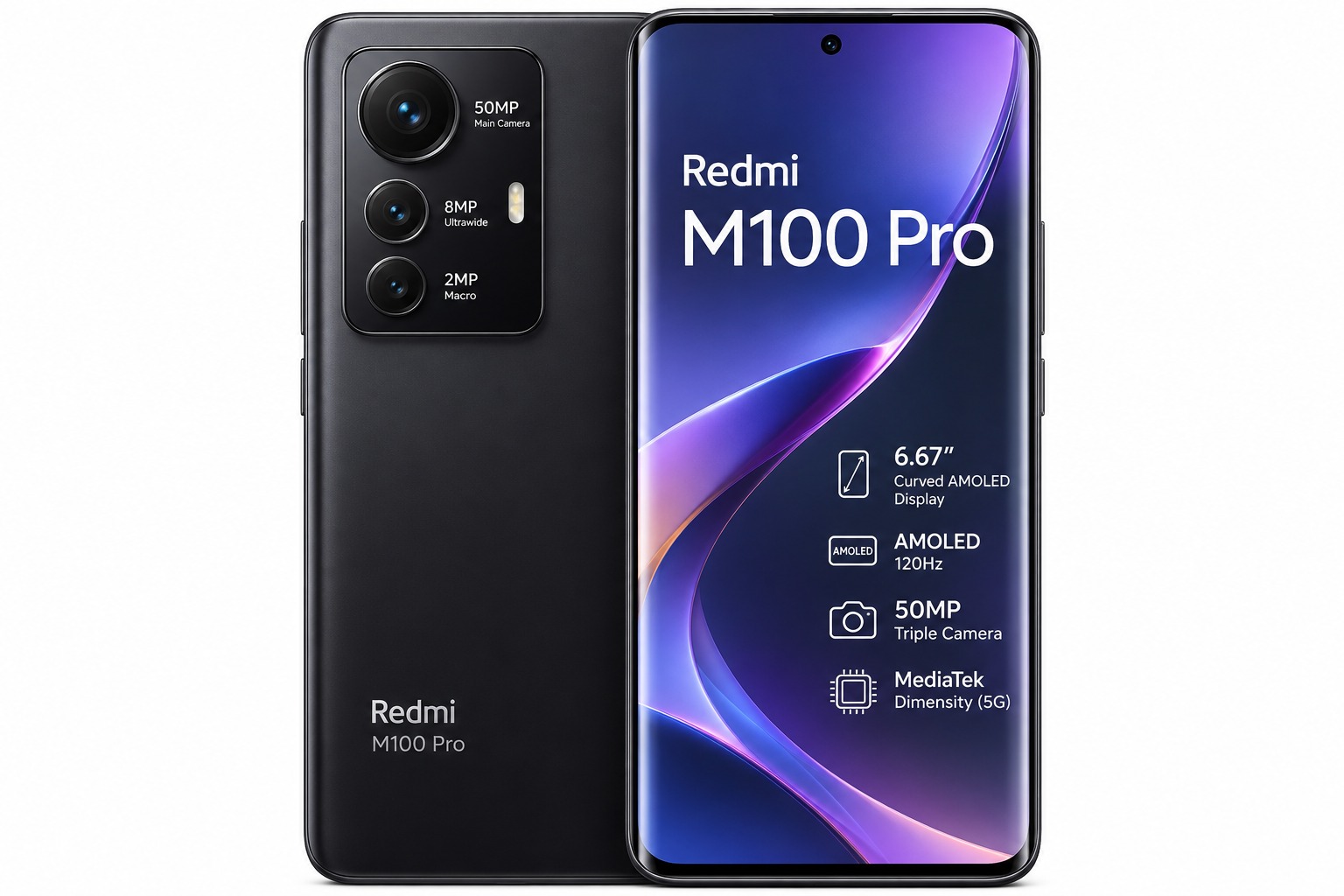
Design and Build Quality
The M100 Pro measures 162.3 x 74.4 x 8.2 mm and weighs 190 grams, which is manageable for a phone with a 6.67-inch screen. The front is protected by Corning Gorilla Glass Victus 2, a pleasant surprise at this price. The back uses a plastic or eco-leather finish depending on the colorway, and the frame is plastic rather than aluminum. That said, the IP68 dust and water resistance rating means you can drop it in a puddle or take it to the beach without panic. The under-display fingerprint sensor is fast and accurately positioned, and the stereo speakers sit at the top and bottom edges.
Four color options are available in China: Midnight Black, Mirror Porcelain White, Phantom Blue, and Twilight Purple. The purple variant uses a leather-like texture that feels grippier than the glossy black or white finishes. There is no 3.5mm headphone jack, and there is no microSD card slot. The USB-C port is USB 2.0, which is a minor disappointment if you plan to transfer large files to a PC.
Display
The 6.67-inch curved AMOLED panel is the strongest argument for this phone. It runs at a native 2712 x 1220 resolution, which translates to roughly 446 pixels per inch. The 120Hz refresh rate is adaptive, so it dials back during static content to save battery. HDR10+ and Dolby Vision are both supported, and the panel can hit a local peak brightness of 3,000 nits. In direct sunlight, the screen remains readable, though the 3,000-nit claim is a local-peak figure rather than a full-screen sustained brightness. The curved edges reduce visible bezels, but they also make the glass more prone to accidental touches when the phone lies flat on a table.
Performance
MediaTek Dimensity 7300-Ultra is a capable mid-range chip built on a 4nm process. The octa-core layout stacks four Cortex-A78 cores at 2.5GHz against four Cortex-A55 cores at 2.0GHz, with a Mali-G615 MC2 handling graphics. In daily use, social media scrolling, messaging, and light gaming feel fluid. The 12GB of LPDDR4X RAM keeps apps in memory reliably, and the 256GB of UFS 2.2 storage is fast enough for general use, though it lags behind the UFS 3.1 found in cheaper competitors like the Redmi Note 17 Pro Max.
Gaming is where the Dimensity 7300-Ultra shows its limits. Titles like Genshin Impact and Honkai: Star Rail run at medium settings with frame rates hovering in the 35 to 45fps range. Thermal management is adequate for short sessions, but the phone does warm up after twenty minutes of 3D gaming. For the average user who plays Candy Crush or watches Netflix, this chip is more than enough.
Camera
The triple rear camera setup consists of a 50MP Sony LYT-600 main sensor with optical image stabilization, an 8MP ultrawide, and a 2MP macro. The 20MP front-facing camera handles selfies and video calls. In good lighting, the main camera produces sharp, well-exposed shots with natural colors. OIS helps in low light, though the small sensor size means night photos still look noisy compared to flagship phones. The ultrawide is usable for landscapes but lacks the dynamic range of the main shooter. The macro lens is a specification win rather than a practical one — details are soft, and the fixed focus makes it hard to get crisp close-ups.
Video recording maxes out at 4K at 30fps with gyro-electronic image stabilization. That is a step behind the Poco X8s, which offers 4K at 60fps. For content creators, the lack of a proper telephoto lens is a genuine drawback. There is no periscope zoom and no optical zoom beyond the main sensor.
Battery and Charging
A 5,500mAh silicon-carbon battery powers the M100 Pro, and Xiaomi claims all-day endurance with heavy use. In real-world testing, that translates to roughly six to seven hours of screen-on time with a mix of browsing, streaming, and social media. The 45W wired charging takes the phone from zero to full in about seventy-five minutes. There is no wireless charging and no reverse charging, which puts it behind rival mid-rangers that have started adding 50W wireless at similar prices. The 5,500mAh capacity is respectable but not class-leading — the Honor X9e Pro 5G packs 11,000mAh, and even the budget Redmi Note 17 Pro Max reaches 10,000mAh.
Software
The M100 Pro launches with Android 16 and Xiaomi’s HyperOS 3. The interface is cleaner than older MIUI builds, with fewer pre-installed apps and a more consistent icon design. Xiaomi promises two major Android upgrades and four years of security patches for this device. That is a reasonable commitment for a mid-ranger, though it falls short of the three to seven-year promises from Samsung and some Chinese competitors. Because this is a China-specific device, it does not ship with Google Mobile Services. The Play Store, Gmail, and Google Maps are absent unless you manually sideload them, which is possible but voids the warranty in some regions. For Filipino buyers, that is the single biggest caveat: GCash, Maya, and most local banking apps rely on Google Play Services and will not run out of the box.
Pros and Cons
| Pros | Cons |
|---|---|
| IP68 rating and Gorilla Glass Victus 2 at this price | No Google Mobile Services on China ROM |
| Bright 1.5K 120Hz AMOLED with HDR10+ and Dolby Vision | 5,500mAh battery is small for 2026 mid-range standards |
| Android 16 and HyperOS 3 out of the box | Only 2 years of major OS updates promised |
| 50MP Sony LYT-600 main with OIS | No telephoto zoom and weak 2MP macro |
| 12GB RAM and 256GB storage as standard | USB 2.0 and no microSD expansion |
| Clean studio design with four color options | China-exclusive with no official global launch plans |
Should You Buy This?
Buy it if
- You live in China and want a budget phone with a bright AMOLED display and solid build quality.
- You prioritize software freshness over maximum battery capacity.
- You do not rely on Google Play Services and can live without GCash, Maya, and local banking apps.
- You want a phone that looks and feels more premium than its price suggests.
Skip it if
- You need Google Mobile Services for daily apps and banking.
- You want the biggest battery possible — rivals now offer 8,000mAh and above at similar prices.
- You care about long-term software support beyond two years.
- You shoot a lot of telephoto or macro photography.
Final Verdict
The Redmi M100 Pro is a competent mid-ranger that carries the best and worst of Xiaomi’s budget strategy. The hardware is sharp: the 1.5K AMOLED is one of the best screens you will find under CNY 3,000, the IP68 rating adds real durability, and the 12GB RAM ensures smooth multitasking. But the 5,500mAh battery feels outdated next to the 8,000mAh-plus phones flooding the market, and the China-only status with no Google Services makes it a hard sell outside its home region.
The honest truth is that this phone exists to feed carrier bundles in China, not to compete on global store shelves. If you can import it and sideload GMS, you get a decent display and a clean software experience for a fair price. But for most buyers, especially in the Philippines, the base Redmi M100 or the better-value alternatives in our 2026 guide are safer choices. The M100 Pro is not a bad phone; it is just a phone built for a different market with different rules.