
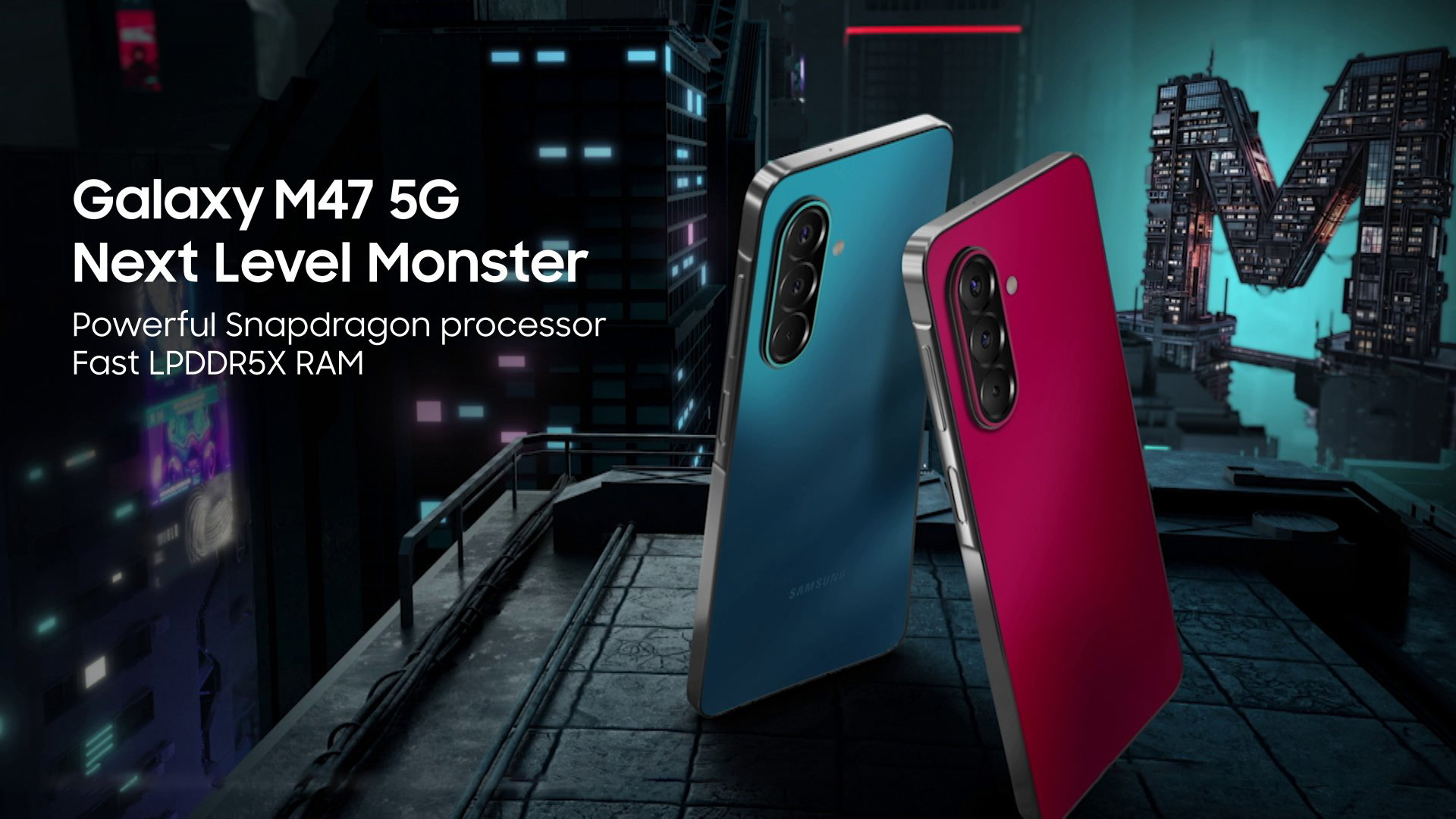
Samsung just dropped a new phone in India that nobody’s really talking about yet — and it might be the best value mid-ranger they’ve made in years. The Galaxy M47 5G launched on June 29 with a spec sheet that reads like Samsung actually listened to what people want: a gigantic battery, a smooth display, and a software promise that outlasts most people’s phone contracts. All for around PHP 15,000 converted.
But here’s the catch: the M-series has always been India-first. If you’re in the Philippines, you’ve probably never touched one. So is the Galaxy M47 worth the effort of importing, or should you wait for the local A-series equivalent? I’ve gone through the specs, the early impressions, and what we know about Samsung’s mid-range playbook to give you the real answer.
Design & Build: Boxy, Clean, and Tougher Than Expected
The Galaxy M47 borrows heavily from Samsung’s 2026 design language — flat sides, a flat back, and a pill-shaped triple camera module that sits flush with almost no bump. It looks closer to the Galaxy A57 than anything in the budget bracket, and that’s a compliment. At 162.4 × 78.2 × 7.8mm and exactly 200g, it’s a substantial phone that doesn’t feel cheap.
Samsung didn’t skimp on durability either. You get Gorilla Glass Victus+ on both the front and back — the same glass used on phones twice the price. There’s also IP64 dust and water resistance, which means it’ll survive rain, splashes, and the occasional dusty commute. It’s rated for drops up to 2 meters, which Samsung claims is four times more scratch-resistant than conventional protective glass.
The color options — Blaze Blue and Rogue Red — lean bold. The Rogue Red in particular has a deep crimson matte finish with metallic red accents around the camera module. It’s not subtle, but it’s distinctive. The side-mounted fingerprint scanner doubles as the power button, which is fast and reliable. No in-display sensor here — Samsung saved that cost and put it toward things that matter more.
Like I noted in my Oppo Reno16 Pro review, mid-range phones in 2026 have gotten genuinely good at build quality. The M47 keeps that trend alive.
Display: A 120Hz AMOLED That Punches Above Its Price
The 6.7-inch FHD+ Super AMOLED panel is one of the M47’s strongest selling points. It runs at 120Hz, hits 1,400 nits of peak brightness outdoors, and has that deep contrast only AMOLED can deliver. Watching Netflix or scrolling through TikTok feels fluid and vibrant — no ghosting, no weird color shifts at angles.
The 800-nit typical brightness might sound modest next to 2026 flagships, but in real-world use, you won’t struggle to read it under direct sunlight. The Gorilla Glass Victus+ protection means you don’t need to slap on a screen protector the moment you unbox it, which is rare at this price.
The bezels are slim with an 86.8% screen-to-body ratio, and the punch-hole front camera is unobtrusive. It’s a standard 19.5:9 aspect ratio, so no weird letterboxing on YouTube videos. The only thing missing is HDR10+ certification — Samsung reserved that for the A57. But at this price, I’m not complaining.
Performance: Snapdragon 6 Gen 3 Gets the Job Done
Under the hood is the Qualcomm Snapdragon 6 Gen 3, a 4nm chip that pairs four Cortex-A78 performance cores at 2.4GHz with four efficiency cores at 1.8GHz. The Adreno 710 GPU handles graphics. This is paired with either 6GB or 8GB of LPDDR5X RAM and 128GB or 256GB of UFS 3.1 storage — both faster than the UFS 2.2 you’d find on most competitors at this price.
In everyday use, the M47 handles social media, web browsing, YouTube, and light gaming without breaking a sweat. The 6 Gen 3 isn’t going to challenge a Snapdragon 8-series chip, but it’s a noticeable step up from the Exynos chips Samsung used to put in this series. Apps launch quickly, multitasking is smooth, and the phone doesn’t heat up during normal use.
For gaming, the Adreno 710 can handle PUBG Mobile and Call of Duty Mobile at medium-to-high settings without frame drops. Genshin Impact will need lower settings, but Samsung’s bypass charging feature — which routes power directly to the phone instead of through the battery during gaming — keeps thermals in check. You can game while plugged in without turning your phone into a hand-warmer.
There’s a microSD slot for expansion, though it shares the SIM tray (hybrid slot). If you need dual SIMs and extra storage, you’ll have to choose.
Cameras: The Main Sensor Carries the Team
Samsung put a 50MP main camera with OIS on the M47, and it’s the camera you’ll actually use 95% of the time. It shoots 4K video at 30fps with gyro-EIS, handles HDR scenes reasonably well, and produces sharp, social-media-ready shots in good lighting. The OIS helps a lot with low-light shots and shaky hands — something budget phones often skip.
The 12MP front camera can also record 4K, which is genuinely uncommon at this price. Selfie quality is solid with accurate skin tones and decent edge detection in portrait mode. Samsung’s AI editing tools — object eraser, photo remaster, and the new Circle to Search integration — add some software flair.
Now the less impressive part: the 5MP ultrawide and 2MP macro sensors. The ultrawide is functional for group shots or landscapes but gets noisy fast when the light drops. The 2MP macro is practically a spec-sheet filler — you’ll use it once, remember why nobody uses macro lenses, and go back to the main sensor. This is the one area where Samsung clearly cut corners, and it shows. As I found with the Redmi 17C, budget phones still struggle to make secondary cameras genuinely useful.
Real-world scenario: you’re at a family dinner, the lighting is warm but not bright. The main camera handles it fine. You switch to ultrawide to fit everyone in — the shot is wider but noticeably softer. That’s the tradeoff you’re making.
Battery Life: The Real Reason to Buy This Phone
The 6,000mAh battery is the M47’s headline feature, and it delivers. With typical use — social media, messaging, an hour of YouTube, some light gaming, and photography — you’ll easily get two full days. Heavy users can still expect to end a long day with 30-40% remaining.
The 45W wired charging isn’t the fastest in 2026 (some Chinese brands push 80W+), but it’s a huge improvement over the 25W Samsung used on previous M-series devices. You’ll go from 0 to 50% in about 30 minutes, and a full charge takes just over an hour. The fast charger isn’t included in the box — Samsung’s been doing this for years now — so factor that into your cost.
Bypass charging is the sleeper feature here. When you’re gaming while plugged in, the phone draws power directly from the charger instead of charging the battery and discharging it simultaneously. This reduces heat and preserves long-term battery health. If long battery life is your top priority, you might want to also look at the Honor X80 Pro Max with its absurd 11,000mAh cell, though that phone is heavier and less refined.
Samsung claims the battery is “engineered for endurance,” and based on the capacity alone, it’ll stay relevant even as Android updates pile on over the years.
Software: Six Years of Updates Changes the Value Equation
This might be the M47’s most underrated feature. Samsung is promising six major Android OS upgrades and six years of security updates — a commitment that’s nearly unheard of in the budget segment. The phone ships with Android 16 and One UI 8.5 out of the box, meaning it’ll eventually see Android 22.
One UI 8.5 is clean and feature-rich. You get Samsung’s ecosystem perks — Quick Share, Samsung Wallet, Knox security, and the always-useful Edge Panel. Circle to Search is built in, letting you circle anything on screen to search it instantly. The AI photo editing tools (object eraser, remaster, style transfer) are genuinely useful, not just gimmicks.
Samsung’s update track record has been excellent in recent years, and this six-year pledge makes the M47 one of the most future-proof budget phones you can buy. In four years, when most phones from 2026 are stuck on old software with security holes, the M47 will still be getting patches. That’s real value.
The only software caveat: single loudspeaker. Media consumption is fine but not immersive. There’s no 3.5mm headphone jack either — Bluetooth 5.3 or USB-C audio are your only options.
Pros and Cons
| Pros | Cons |
|---|---|
| Massive 6,000mAh battery with 45W charging | 5MP ultrawide and 2MP macro cameras are weak |
| 120Hz Super AMOLED with Gorilla Glass Victus+ | No in-display fingerprint sensor |
| 6 years of OS and security updates | Single speaker, no headphone jack |
| Snapdragon 6 Gen 3 with UFS 3.1 storage | Not officially available in the Philippines |
| IP64 water resistance and 2m drop rating | WiFi 5 only (no WiFi 6) |
| 50MP main camera with OIS, 4K video | Fast charger not included in box |
| Bypass charging for gaming | Hybrid SIM slot (dual SIM or microSD) |
Should You Buy the Samsung Galaxy M47?
Buy it if: you want maximum battery life and long-term software support on a tight budget. The M47 delivers flagship-level endurance and update longevity at a mid-range price. If you’re a heavy user who forgets to charge, or someone who keeps phones for 4-5 years, this is built for you.
Skip it if: camera versatility matters to you. The main sensor is good, but those secondary cameras are a letdown. If you regularly use ultrawide or zoom, you’ll be frustrated. Also skip if you need official local warranty — importing from India means you’re on your own for repairs.
Wait for the A-series if: you want something similar with official Philippine availability. The Galaxy A27 or A37 will likely share much of the M47’s DNA, though expect a smaller battery and a higher price tag. That’s Samsung’s mid-range tradeoff: M-series for battery and value, A-series for availability and polish.
At INR 22,999 (about PHP 14,900 converted), the Galaxy M47 is a compelling argument for why you don’t need to spend flagship money in 2026. It’s not perfect — those secondary cameras are disappointing, and the India-only launch means Philippine buyers have to work a little harder to get one. But for what it costs, the combination of a 6,000mAh battery, six years of updates, and a genuinely good 120Hz AMOLED display makes it one of Samsung’s best value propositions this year.
Six years from now, when this phone is still getting security patches and your friend’s “flagship killer” is collecting dust on its final OS version, you’ll know you made the right call.