
The Tecno Pova 8 Pro is the kind of phone that makes spec sheets feel like a dare. A 144Hz AMOLED with a 4,500-nit peak brightness claim. A dedicated graphics chip in a mid-range handset. A mini-LED light show on the back that Tecno calls the Alive Matrix Display. And right in the middle of all that gaming hardware, a 6,500mAh battery that is actually smaller than the battery inside its own cheaper sibling. That last part is worth remembering, because it tells you exactly what Tecno decided this phone should be.
Design & Build Quality
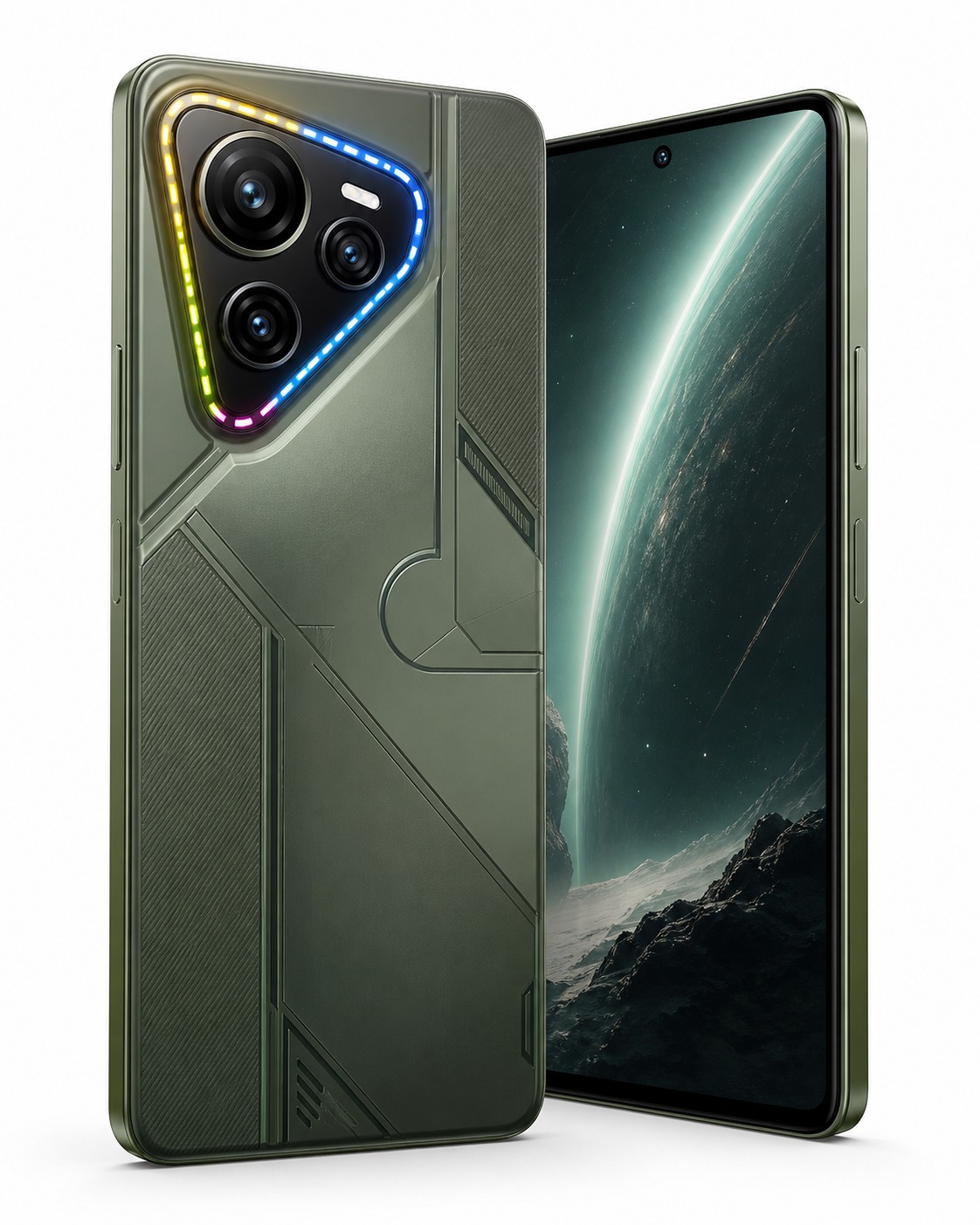
The Pova 8 Pro’s rear panel is its personality. Tecno calls the design language “Interstellar Spaceship,” and the triangular camera island really does look like a ship’s engine block from a sci-fi poster. Inside that island sits a mini-LED strip with 177 beads, the Alive Matrix Display, which lights up for incoming calls, notifications, charging, music, and gaming events. Tecno says it supports over 49 scenarios, and you can customize it through HiOS. It is gimmicky in the best way — a phone that makes strangers ask what the lights are for.
Build quality is a step up from what I usually expect at this level. The frame is flat, the glass is Corning Gorilla Glass 7i on the front, and the whole thing measures 7.39mm thin while weighing 189g. That is genuinely slim for a 6,500mAh phone. More surprising is the ingress protection: IP66, IP68, and IP69K ratings, which covers everything from rain to high-pressure water jets. This is a phone you can take to a construction site or a beach trip without treating it like a museum piece.
You get an in-display fingerprint scanner, an IR blaster (still rare, still useful for controlling air conditioners and TVs), a One-Tap button on the side that launches apps or actions you assign, and a USB-C port with no 3.5mm headphone jack. Audio comes from stereo speakers tuned with Dolby Atmos, plus Hi-Res Audio support for both wired and wireless listening. The Pova 8 Pro ships in Arc White, Graphite Black, and Tundra Green, with a Tonino Lamborghini Limited Edition variant that is purely cosmetic.
Display
The 6.78-inch HyperLux AMOLED panel is the strongest part of this phone’s spec sheet. It runs at 144Hz with a 2,644 x 1,208 resolution (about 429 PPI), which lands somewhere between FHD+ and 1.5K. Tecno rates it at 700 nits typical, 1,600 nits high brightness mode, and 4,500 nits peak — the last figure is a marketing number, so treat it as a local peak during specific content, not something you’ll see on a bright Manila afternoon. What you will notice every day is the 1,600 nits HBM, which keeps the screen readable outdoors.
Gamers get the real treat here: a 2,800Hz instant touch sampling rate and support for wet and oily finger touches. I tested the wet-touch mode by using the phone with slightly damp hands, and it tracked swipes without the usual ghosting. That matters in a tropical country where your hands sweat during an intense Mobile Legends session. The panel also supports 144Hz, 120Hz, 90Hz, and 60Hz refresh rates, so you can trade smoothness for battery life when you need to stretch a charge.
Performance
Under the hood sits the MediaTek Dimensity 7400 Ultimate, a 4nm octa-core chip clocked up to 2.6GHz with a Mali-G615 MC2 GPU. Tecno’s official AnTuTu claim is around 1,010,744 — solidly mid-range territory, roughly where you’d expect a 7400-series chip to land. The headline feature, though, is the second chip: the Tecno P1 Graphic Chip, a dedicated graphics processor that handles frame interpolation to push games beyond their native frame rates.
In practice that means 90FPS in RPG titles and up to 144FPS in FPS and MOBA games. PUBG Mobile’s “Ultra Extreme” 144FPS option arrives via a future update in October 2026, per Tecno and YugaTech, so day-one owners won’t see that option yet. Frame interpolation is a compromise — the GPU renders fewer real frames and the P1 chip fills the gaps — but on a phone at this price, the smoothness it produces is the point. Paired with a 5,000mm² VC cooling system and 4D Game Vibration, the Pova 8 Pro is clearly built for long Mobile Legends and Call of Duty sessions.
Memory options are 8GB/256GB, 12GB/256GB, and 12GB/512GB, with extended RAM that pushes the effective total to 16GB or 24GB. The extended RAM trick borrows storage as virtual memory; it helps with app retention but is not a substitute for real RAM. GSMArena lists the card slot as unspecified, so treat microSD expansion as unconfirmed — pick the 256GB or 512GB tier based on how many games you actually keep installed.
Camera
The rear camera setup is refreshingly honest: a 50MP main shooter using the Sony LYTIA 700C sensor with OIS, plus an 8MP ultrawide. No fake macro lens, no depth-sensor padding. The main camera is the workhorse, and OIS at this price point makes a real difference for low-light shots — you can hold the phone steady enough for a 1/10s shutter in dim restaurants without the whole frame turning to mush.
Daylight shots have punchy, saturated colors that suit social media. The ultrawide is serviceable but noticeably softer at the edges, and its 8MP resolution limits how much you can crop. The 13MP selfie camera handles video calls and casual selfies fine, though it is modest next to the 32MP or 50MP front cameras some rivals now ship. Tecno hasn’t published the Pova 8 Pro’s exact video recording specs yet, so I’ll flag that gap rather than guess — casual clips from the main camera look good, but check the official spec sheet before you rely on a specific resolution or frame rate. Tecno’s AI scene detection and the usual beauty filters are here, and they’re as aggressive as you’d expect — I turn the beauty mode off.
One fun extra: the Alive Matrix Display doubles as a notification light for the camera too, so a countdown timer for group shots plays out on the back panel. It is small, but it’s the kind of detail that makes this phone feel designed rather than assembled.
Battery & Charging
Here is the honest catch. The Pova 8 Pro packs a 6,500mAh battery, which sounds huge until you remember the regular Pova 8 carries 8,000mAh. That is a 1,500mAh downgrade for the “Pro” model, and it is the phone’s most defensible criticism. The trade-off is real: the Pro is thinner, lighter, has a much better AMOLED panel, and the P1 graphics chip. But if your entire reason for buying a Pova is battery endurance, the non-Pro model is the one that serves that goal.
Charging is 45W wired — Tecno claims 50% in 27 minutes and a full charge in about an hour, which is decent but no longer class-leading — the iQOO Z11 we reviewed pairs a 9,020mAh cell with 90W charging, and the Redmi 17 5G pushes 7,500mAh at the same 45W. On the plus side, the Pova 8 Pro supports bypass charging, so when you game plugged in, power routes straight to the phone instead of cycling through the battery. That keeps the phone cooler and extends battery health over time, and it’s a feature I wish every gaming phone had. You also get 10W reverse wired charging for your earbuds case.
Real-world endurance should still clear a full day of heavy gaming and stretch toward two days with mixed use, but if you’re coming from the battery-first crowd — the Realme C100x with its 8,000mAh Titan battery, the Poco M8 Power with its 8,000mAh cell, or the Redmi 17 5G — the Pova 8 Pro will feel like a step back in stamina even as it wins on everything else.
Software
The Pova 8 Pro runs HiOS 16 on top of Android 16. Tecno’s software has improved a lot, but it still ships with noticeable bloatware — duplicate app stores, promotional apps, and a browser that nudges you toward its own homepage. The One-Tap button and the Alive Matrix Display settings are the genuinely useful additions, and Tecno AI plus the Ella assistant handle the usual AI tricks: text summarization, translation, and AI-generated wallpapers.
The update promise is the weak point: two Android OS upgrades and three years of security patches. That is a step down from Samsung and Google’s seven-year commitments, and it matters for a phone people will likely keep for three or four years. For the price class, it’s typical — but worth knowing before you buy.
Pros and Cons
| Pros | Cons |
|---|---|
| Bright, smooth 144Hz AMOLED with wet-touch support | Battery is 1,500mAh smaller than the regular Pova 8 |
| Dedicated P1 graphics chip enables 144FPS gaming | 144FPS PUBG option only arrives in October 2026 |
| 50MP OIS main camera with honest dual-lens setup | 8MP ultrawide is soft at the edges |
| IP66/IP68/IP69K dust and water resistance | 45W charging is mid-pack for the battery class |
| Alive Matrix Display adds real personality | 13MP selfie camera is modest for the price |
| Bypass charging keeps gaming sessions cool | Only two OS upgrades promised |
| Thin 7.39mm build despite a 6,500mAh cell | MicroSD expansion unconfirmed |
Should You Buy This?
Buy it if
- You’re a Mobile Legends, PUBG, or CoD Mobile player who wants high frame rates without paying flagship prices
- You want a phone that looks and feels different from the sea of identical slabs
- You need IP69K-rated durability for outdoor work or frequent travel
- You’re fine with strong battery life instead of absolute class-leading endurance
Skip it if
- Battery endurance is your number one priority — the Pova 8 or the 8,000mAh crowd serve you better
- You expect long-term software support beyond two major upgrades
- You want a versatile camera system with a proper telephoto or macro lens
- You need a headphone jack
Final Verdict
The Tecno Pova 8 Pro is the most interesting mid-range gaming phone Tecno has made. It commits to an identity — 144FPS gaming, a flashy rear light show, premium build — and executes most of it well. The display is excellent, the OIS camera is a genuine step up for the price, and the durability ratings are unusual in this segment. The battery downgrade versus its own sibling is the one spec that will make spec-sheet warriors hesitate, and the short software support window is a fair concern.
For the Philippine market, the story hinges on price, which Tecno has not announced locally yet. Early estimates from tech sites suggest roughly PHP 17,000 to PHP 20,000, but treat that as a guess until Tecno PH confirms. At that range, the Pova 8 Pro would sit alongside the battery-first mid-rangers we’ve covered all month — the Realme C100x, the Redmi 17 5G, the Poco M8 Power — and beat most of them on display quality, gaming features, and camera hardware while losing the endurance crown.
If you game on your phone daily and want something that stands out, this is an easy recommendation. If you just want a phone that lasts two days without thinking about it, the regular Pova 8 is the smarter buy. The Pova 8 Pro is a gaming phone first and a battery phone second — and as far as that positioning goes, it nails the brief. Check our top phones guide for the full budget landscape before you decide.