
Apple finally did it. After eight years of watching rivals sell foldables, the company dropped its own at Wednesday’s “Surprise and Shine” event: the iPhone Duo, the first iOS-powered foldable. It’s not cheap — it starts at $1,999 — but it is easily the most anticipated phone announcement of the year, and new CEO John Ternus made sure it stole the spotlight from the iPhone 18 Pro and Pro Max that launched alongside it.
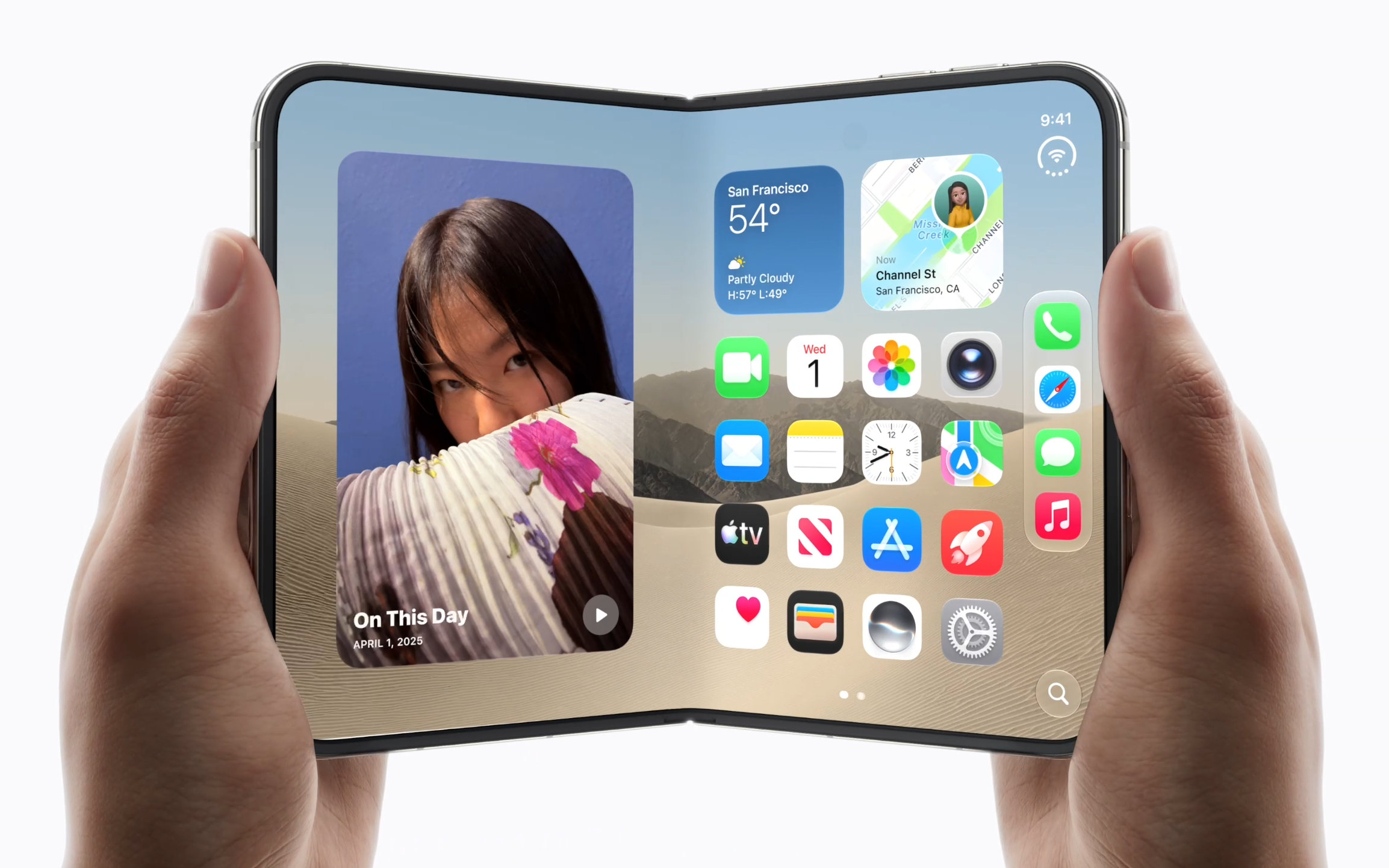
Here’s the thing about the Duo that took me a minute to wrap my head around: both its screens share the exact same aspect ratio. Folded closed you get a 5.4-inch cover display about the size of a passport. Open it book-style and a 7.6-inch folding panel appears. Content moves between the two without reflowing oddly, because Apple deliberately kept the proportions identical. It’s a small detail, but it’s the kind of design discipline that separates a first-gen Apple hinge from the crowd.
Design & Build Quality
The Duo is built around a Grade 5 titanium frame with a magnetic hinge array that snaps the phone shut with a satisfying click. It’s rated IP68 against dust and water, and it ships with Ceramic Shield on the back and Ceramic Shield 2 on the folding screen. There’s a custom nano-texture finish on the inner display that spreads reflections out and does about as much as any first-gen foldable can to hide the crease.
At 254 grams it’s heavier than an iPhone 18 Pro Max, no surprise given the hinge and extra screen. But when unfolded it measures just 5.2mm thick — Apple says it’s the thinnest iPhone it has ever made. In your hand it feels like a hardcover book’s spine: solid, premium, and clearly built to last. It comes in two colours, Star White and Night Sky black. There’s no 3.5mm headphone jack, which is standard for the brand at this point.
One notable change: the Duo swaps Face ID for Touch ID in the side button. That’s a first for a modern flagship iPhone, and it exists because there simply isn’t room for the Face ID sensor array under a folding display. You can also unlock it with your Apple Watch if your hands are full.
Display
Both panels are Super Retina XDR OLEDs running Apple’s ProMotion adaptive refresh, hitting up to 120Hz. Peak brightness is a claimed 3,000 nits on both — that’s a massive number for outdoor visibility, and I’ll be curious to see it measured once units ship in October.
The 7.6-inch inner screen runs at 1878×2670 resolution and is 50% larger than the iPhone 18 Pro Max’s display. The 5.4-inch outer screen still holds 90% of the iPhone 18 Pro’s screen area when closed. Because both share the same aspect ratio, apps and videos transition cleanly from one panel to the other — no letterboxing surprises when you open the phone mid-video.
Apple also added Always-On display support and a patented under-display selfie camera on the fold. The nano-texture finish cuts glare in bright rooms and does a decent job of downplaying the crease line, though no first-gen foldable fully erases it.
Performance
Inside is the A20 Pro, the same chip powering the iPhone 18 Pro and Pro Max — a 2nm processor with a 6-core CPU, 7-core GPU, and a dual 16-core Neural Engine. Apple says it’s 20% faster on the CPU and up to 40% faster on the GPU than last year’s A19 Pro, with double the Neural Engine compute and 50% more unified memory bandwidth. The Duo ships with 12GB of RAM, which is welcome headroom for running two apps side by side.
The experience is smooth whether the phone is folded or open — I caught myself watching content slide from the cover screen to the big display without a stutter. A vapor chamber cooling system helps the A20 Pro sustain heavy workloads like gaming and video inside the cramped foldable body, which is precisely the area where many foldables traditionally throttle.
Storage runs 256GB, 512GB, 1TB, or 2TB with no card slot, matching the Pro series. For the price of entry, the 256GB base feels a little lean, but the 2TB option is there if you really want to throw money at local 4K video.
Camera
Unlike the triple-camera iPhone 18 Pro lineup, the Duo keeps things to a dual 48MP setup. There’s a 48MP Fusion main with an integrated “optical-quality” 2x telephoto mode and sensor-shift OIS, plus a 48MP ultrawide that doubles as a macro shooter. The main shows the same sensor as the iPhone 18 Pro series, so expect the same strong Photonic Engine processing.
Losing a dedicated telephoto is the most obvious sacrifice next to the Duo, and it’s worth being honest about: for $1,999, some buyers will want a third lens. The 2x crop mode does a solid job for portraits, but it’s not a true optical zoom tower.
Up front there are two selfie cameras: a 12MP Center Stage cover camera for when the phone is closed, and an under-display FaceTime camera hiding inside the folding screen. The under-display unit is more of a calling card for full-screen use than a spec champion — its resolution is still TBD, and the camera quality from under-display sensors is typically a step down. Video hits 4K at up to 120fps with Dolby Vision and spatial 3D audio recording.
Battery & Charging
Apple uses a dual-battery design — one cell on each side of the hinge — which is how it fits a large capacity into the thin body. GSMArena lists the combined capacity around 5,800mAh, which would be the largest battery Apple has ever put in an iPhone.
Battery life claims are strong: up to 31 hours of video playback on the inner display, 44 hours on the outer display, and a day of mixed use with both. Wired charging adds 50% in about 20 minutes with a 60W+ adapter, while wireless MagSafe or Qi2 charging hits 50% in around 30 minutes. That’s much faster top-up than the standard iPhone, which I appreciate given how much screen there is to light up.
One catch to flag for buyers in markets like the Philippines: the Duo is eSIM-only worldwide — there is no physical SIM tray. For travellers or anyone on carriers without solid eSIM support, that’s a genuine planning consideration before you commit.
Software
The Duo runs iOS 27, specially adapted for the two-display design. The UI reorients as the phone folds, turns, or flips; the lock screen, home screen dock, and app controls shift to the side of the display to preserve vertical space. Unfolded, the home screen shows two pages at once, and Split View lets you run two apps or two windows of the same site side by side — handy for comparison shopping.
Apple has redesigned the status bar as a flexible circular interface tucked into the corner, and the Dynamic Island moves to the side of both screens to present alerts and Live Activities. You can save app pairs you use together and reopen them with a tap. The Duo also gains support for the Apple Pencil later this year — the first iPhone ever to do so.
Contrast the Duo against the software of the Xiaomi 18 Fold, and Apple’s advantage is polish: iOS 27 was clearly designed for a foldable from day one, not bolted on after the fact.
Pros and Cons
| Pros | Cons |
|---|---|
| Beautiful 7.6″ inner display, 3,000-nit peak, same aspect ratio on both panels | No separate telephoto lens at a $1,999 starting price |
| Thinnest iPhone ever when unfolded, Grade 5 titanium build | eSIM-only — no physical SIM tray, a real hurdle for some regions |
| Fast A20 Pro with vapor chamber cooling and 12GB RAM | Under-display selfie cam resolution unconfirmed, quality a step down |
| Dual-battery design with strong endurance and fast 60W+ top-up | Only two colours at launch |
| Touch ID returns + Apple Watch unlock, IP68 durability | 256GB base storage feels lean at the entry price |
| Apple Pencil support, smart iOS 27 foldable UI | No Face ID on the folding screen |
Should You Buy This?
Buy it if
- You’re deep in the Apple ecosystem and want a larger canvas for multitasking, video, and the Apple Pencil.
- You value build quality and software polish over raw specs, and have ever considered a Galaxy Z Fold8 Ultra.
- You want a folding phone that feels like an iPhone first and a foldable second.
Skip it if
- You need a physical SIM, a dedicated telephoto lens, or the most camera hardware possible for the money — a flagship like the Pixel 11 Pro Fold may fit better.
- $1,999 is a stretch, or you’re on a carrier without eSIM support.
- You want a dedicated telephoto zoom lens.
Final Verdict
Apple waited until the foldable category stopped being a gimmick, and the iPhone Duo shows it. The build quality is unmistakably first-tier, the display pairing is clever rather than gimmicky, and iOS 27 genuinely uses the bigger screen instead of just stretching a normal interface across it. For what is technically Apple’s first attempt at the form factor, this is a remarkably confident piece of hardware.
At $1,999 it lands $100 below the starting price of the Galaxy Z Fold8 Ultra and undercuts the eye-watering Huawei Mate XT 2. But for Philippine buyers it’s worth remembering the last big foldables — like the Z Fold8 Ultra I reviewed at ₱123,990 — already command a heavy local premium, and the Duo’s eSIM-only design adds another layer of consideration before import.
This is a phone for a specific kind of person: someone who lives inside Apple’s ecosystem, wants the largest possible iPhone canvas, and accepts genuine compromises — a lean 256GB base, no dedicated telephoto, and an under-display selfie cam that remains a question mark — in exchange for a foldable that simply feels finished. Pre-orders open October 16, with release on October 23. If that sounds like you, the Duo is the most interesting iPhone Apple has shipped in years. If a six-figure foldable isn’t in the cards right now, my top phones for every budget in 2026 will point you somewhere more sensible.
Note: The iPhone Duo ships October 23, so real-world endurance, camera, and thermal results still need independent testing. Specs cited here come from Apple’s official materials via GSMArena and confirmed by launch coverage.