
BYD just gave its smallest car a proper name, and it’s aimed squarely at the two sub-million EVs already parked on Philippine streets. Meet the BYD Great Seagull — the upsized Seagull that the Ocean-series general manager, Zhang Zhuo, confirmed during the Chengdu Auto Show this week is heading to China before the year ends. Officially, it’s BYD’s answer to the Geely EX2 and the GAC Aion UT. And both of those sell here.
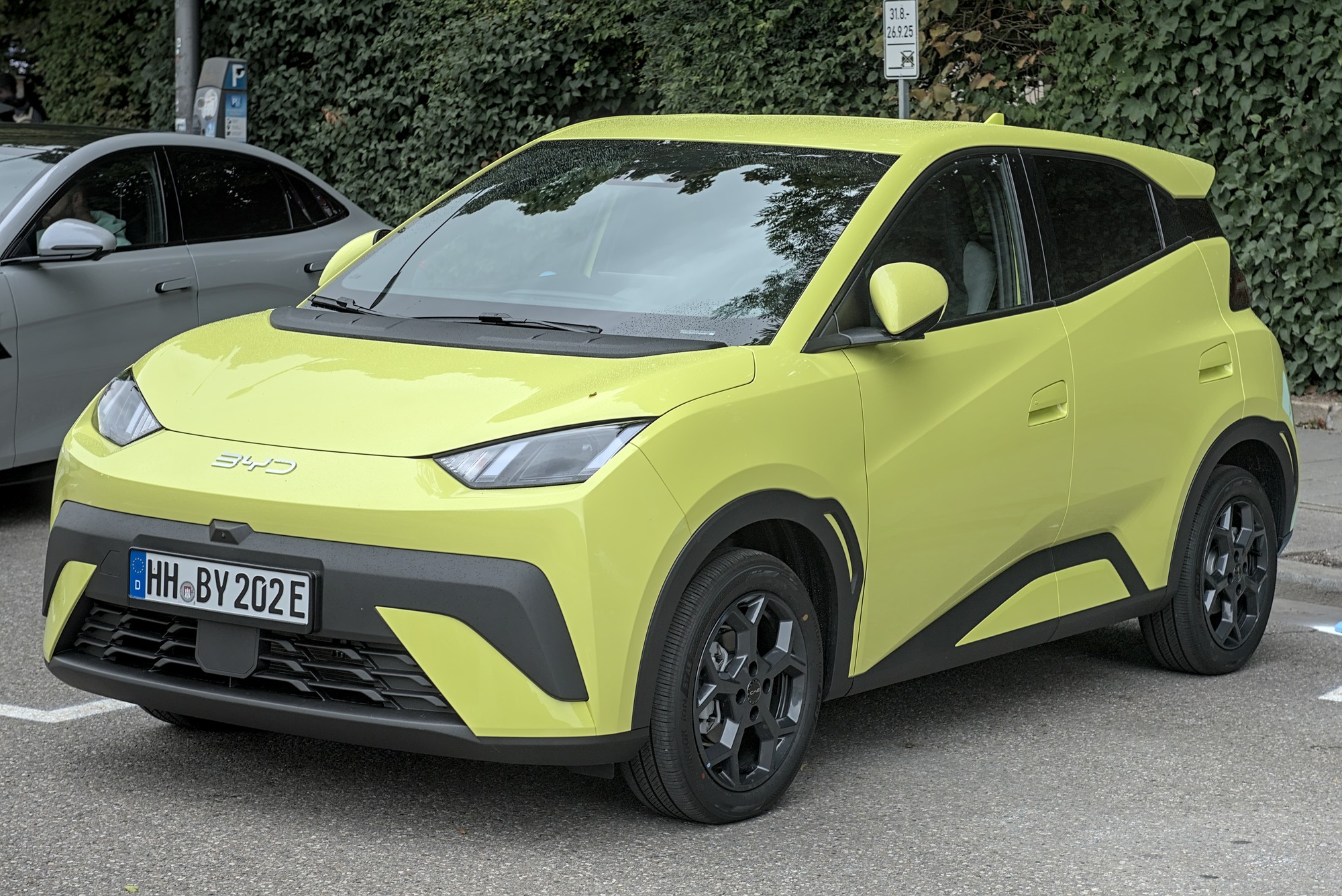

That’s the part that caught my attention. When a carmaker explicitly names the two competitors it’s chasing, and both happen to be on sale in Manila, it’s worth paying attention to what comes next.
A Real Name for a Bigger Seagull
Until this month, the larger Seagull was just a next-gen rumor floating through Chinese regulators’ approval lists. Now it has a badge: Great Seagull, or Da Haiou. The naming follows BYD’s recently released Da Tang (Great Tang) and Da Han (Great Han), so this is a deliberate product-line move, not a facelift.
The dimensions are what sell it as a step up. The Great Seagull stretches to 4,205mm long, 1,810mm wide, and 1,570mm tall on a 2,650mm wheelbase. That’s 425mm longer than the current Seagull and just 65mm shorter than a Dolphin. It’s still a B-segment hatch — it just leans firmly toward the bigger end of that class, exactly the slot the Geely EX2 and GAC Aion UT occupy in the Philippine market.
This build on the next-gen Seagull story we looked at a couple of weeks ago, but now with a confirmed badge and a launch window.
BYD Great Seagull — Key Specs (As Reported)
| Specification | BYD Great Seagull |
|---|---|
| Body style | B-segment electric hatchback |
| Dimensions | 4,205 × 1,810 × 1,570 mm |
| Wheelbase | 2,650 mm |
| Motor | Single e-motor, 95 kW (127 hp) |
| Battery | FinDreams LFP, 30 kWh or 39.2 kWh |
| Range | 320–420 km (CLTC) |
| Top speed | 150 km/h |
| Wheels / tires | 16-inch, 205/60 |
| Curb weight | 1,180–1,255 kg |
| Smart driving | Possible DiPilot 300 (God’s Eye B), LiDAR |
The powertrain keeps things simple: one permanent-magnet synchronous motor making 95 kW, or about 127 hp, fed by either a 30 kWh or 39.2 kWh lithium iron phosphate pack. Range lands between 320 and 420 km on China’s CLTC cycle. Top speed is a modest 150 km/h.
There’s a smarter twist under the surface. Spy shots from China’s road tests show a roof-mounted LiDAR pod, which hints the Great Seagull could carry BYD’s DiPilot 300, or “God’s Eye B” — the mid-tier system with Navigate-On-Autopilot for city and highway driving. If that trickles into an entry-level hatch, it would raise the bar for this budget segment.
What People Are Saying
International coverage has centered on the positioning. CarNewsChina broke the confirmation from Chengdu, framing the Great Seagull as BYD’s cheaper, less-powerful alternative to the Dolphin — and noting it could effectively replace the entry-level Dolphin the way the market shakes out. BYD moved 8,879 Seagulls in China last month, so the demand for a bigger version is easy to see.
Local outlets picked it up fast. Top Gear Philippines ran it the next day, calling attention to the 127-hp motor and the fact that it’s been sized and spec’d to go toe-to-toe with the EX2 and Aion UT. Autocar Philippines similarly read it as a pure practicality play for the small-EV crowd.
Nobody’s confirmed a Philippines launch date or local price yet. That’s the honest state of it — the Great Seagull is announced for its home market this year, and a global rollout is a “watch this space” situation.
How Much Would It Cost Here?
There’s no official PH pricing, so treat the numbers below as estimates anchored on what the current Seagull and its rivals already cost locally. The current Seagull lists at ₱898,000; the Geely EX2 runs ₱938,000–₱1.038M, and the GAC Aion UT sits at ₱998,000. A Great Seagull that lands between its smaller sibling and the Dolphin would plausibly slot around ₱1.0–1.2M.
| Market | Price |
|---|---|
| Philippines (projected estimate) | ~₱1,080,000 |
| USD equivalent | ~$17,400 |
| INR equivalent | ~₹16.6 lakh |
| China (current Seagull reference) | from 69,900 yuan (~$10,000) |
(Conversions at roughly 62.0 PHP/USD and 95.5 INR/USD, late August 2026. PH figure is an estimate until BYD Philippines announces an official SRP.)
To frame that properly against what’s already here: it sits in the same bracket as the EX2 and Aion UT, exactly where BYD says it’s aiming. That’s a tight, competitive lane, and it’s filling up fast.
Is the Great Seagull Right for the Philippines?
Assuming BYD Philippines brings it over, here’s how a 127-hp hatch with 320–420 km of range would hold up in actual Filipino driving.
City Driving
This is where the Great Seagull would shine. At 4.2m it’s still short enough to weave through EDSA and slot into Makati and BGC parking, and instant torque from the e-motor makes stop-and-go traffic painless. The 320-km entry pack is comfortably more than a typical week of city commutes, so you’d rarely think about charging mid-week.
Long-Distance Travel
Manila to Baguio is about 250 km one way, which the 420-km version could handle on a single charge in ideal conditions — the kind of trip the smaller 305-km Seagull couldn’t comfortably promise. Real-world range will be tighter than CLTC numbers, so a quick top-up on NLEX or SCTEX before the climb is still the smart habit. Highway pace is fine, though 150 km/h is a firm cap.
Flooded Streets
As an EV with no engine to hydrolock, it has a natural advantage in flooded Metro Manila streets. But this is a low, hatchback-shaped car with no water-fording claims published, so the golden rule applies: don’t wade into water you can’t see through. Battery submersion ratings aside, treat standing floods as a detour, not a challenge. The LFP chemistry is thermally stable, which is reassuring.
High Temperatures
LFP packs hold up well in our 36–38°C heat, and the bigger battery means the air-conditioning load doesn’t gut the range as fast as it would in a tiny 18 kWh city car. LiDAR and ADAS cameras in this climate do need clean lenses and clear wiring, so expect some sensor-cleaning maintenance — a small trade-off for the driver-assist promise.
The bigger-picture point is battery economics. The more LFP cells BYD churns out across cars like this, the more the whole batteries-are-the-bottleneck conversation shifts in buyers’ favor over time.
Bottom Line
The Great Seagull is, on paper, exactly what the budget EV tier in the Philippines has been missing: bigger than the Seagull, sized and spec’d directly against the EX2 and Aion UT, with a range that makes it a genuine one-car solution for city and weekend trips. The LiDAR-equipped driver-assist option would be a headline for this class.
BYD has made no secret of treating the local market as a priority — the brand’s momentum here is real and well-documented. When this one reaches China by year’s end and a global rollout follows, you can bet a Philippine release will be near the front of the line. Until BYD Philippines confirms pricing, watch the lane it’ll crowd: the same one the EX2, Aion UT, and the rest of the budget EVs are fighting over right now.