
Another Chinese new-energy brand is knocking on our doors, and this time it’s got square shoulders and a fondness for boxy, retro lines. iCaur — the brand under the Chery Auto umbrella — is officially coming to the Philippines, with the local launch set for October. When it lands, it’s bringing two very different rides: the all-electric V23 crossover and the V27, a big range-extended SUV.
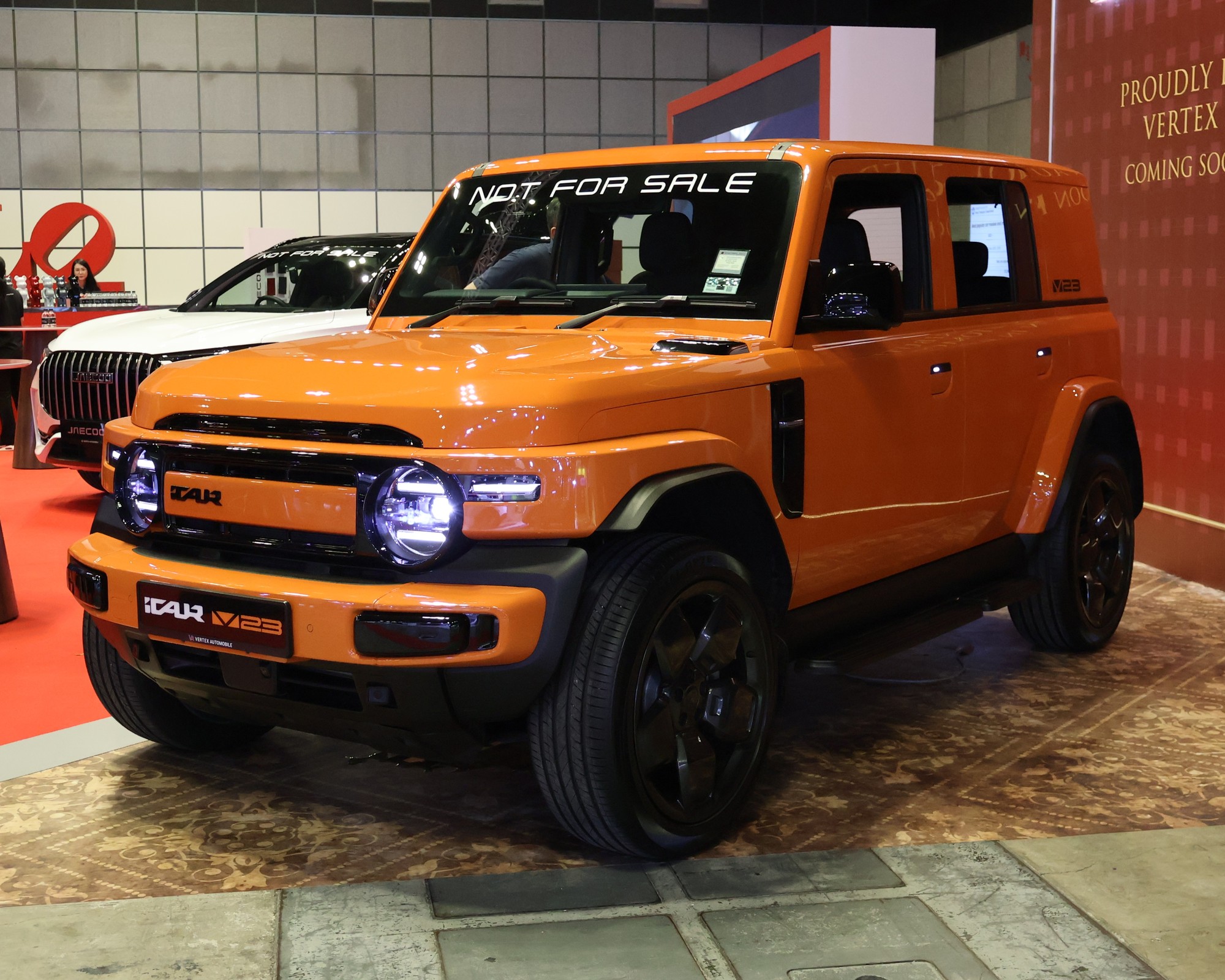
_Showcar_iCaur_V23_No-plate_2026-01-09.jpg)
iCaur is entering the local market this October, distributed by Omoda Jaecoo Philippines. It launches with the V23, a fully electric compact SUV that’s been the brand’s global sales leader, and the V27, a range-extended SUV that pairs an electric motor with a petrol generator for long-haul peace of mind. Let’s dig into what we know so far.
Who Is iCaur, and Why Should You Care?
iCaur comes from the Wuhu, China-based Chery Auto stable — the same parent behind Omoda and Jaecoo, brands you’ve probably seen popping up all over Metro Manila lately. It’s actually a collaboration between Chery and SmartMi Technology, a core ecosystem supply partner of Xiaomi.
The letter “i” in the name stands for Inner Self, Intellect, Imagine, and Interactive. Rather than chasing flashy trends, iCaur’s design language leans on what it calls “Classic Never Fades” — boxy, restrained proportions with clean, timeless lines. Think retro-futuristic rather than screaming edge.
Globally, the brand has momentum to back this up. It’s reportedly led Southeast Asia’s boxy NEV segment for several consecutive months and passed 100,000 units in cumulative sales. It also runs a global owner community called i-CLUB, which ties into its heavy push on personalization and lifestyle culture — owners are encouraged to mod their cars to fit their tastes.
What’s Coming to the Philippines
When iCaur arrives in October, it’ll roll out two models to anchor its Philippine lineup:
- iCaur V23 — an all-electric, boxy crossover and the brand’s global flagship
- iCaur V27 — a larger all-rounder SUV riding on the brand’s “Golden REEV” range-extended electric platform
An important note: Omoda Jaecoo Philippines will distribute the brand, but iCaur vehicles are set to be sold through independent dealerships — not the existing Jaecoo showrooms. How the Jaecoo side has handled its own electric push, our JAECOO J5 EV coverage lays out the value-focused EV playbook.
The iCaur V23: A Compact EV With Retro Flair
The V23 is the boxy EV crossover that’s done much of the selling for the brand in regional markets. It’s a compact SUV — about 4,220 mm long with a 2,735 mm wheelbase — so it slots into the same neighborhood as the BYD Atto 2 and MG S5.
Local specs haven’t been locked in yet (more on that below), but international versions give us a clear picture. It’s offered in rear- and all-wheel-drive trims:
V23 specs (international)
| Spec | V23 RWD | V23 AWD |
|---|---|---|
| Motor | Single, 100 kW (136 PS) | Dual, 155 kW (211 PS) |
| Torque | 180 Nm | 292 Nm |
| Drive | Rear-wheel drive | All-wheel drive |
| Battery | 59.93 kWh | 81.8 kWh |
| Range (NEDC) | 360 km | 430 km |
| 0-100 km/h | 11.0 s | 7.5 s |
| Top speed | 140 km/h | 140 km/h |
| Ground clearance | 205 mm | 210 mm |
| Length / Wheelbase | 4,220 mm / 2,735 mm | 4,220 mm / 2,735 mm |
Both trims ship with faux-leather upholstery, a 15.4-inch central touchscreen, and six airbags as standard, at least on export models. The AWD flagship adds a 540-degree camera, an off-road driving mode, and a fuller ADAS suite.
The iCaur V27: A Bigger REEV With 1,000 km of Range
The V27 is the more interesting proposition for Philippine buyers, honestly, because it tackles the two biggest EV fears at once: range anxiety and charging. It’s a range-extended EV (REEV), meaning an electric motor drives the wheels while a petrol engine acts as a generator to keep the battery topped up. Think of it as an EV with a safety net.
V27 specs
| Spec | iCaur V27 |
|---|---|
| Motor | Dual motor, AWD, 449 hp |
| Torque | 505 Nm |
| 0-100 km/h | 5.9 s |
| Top speed | 180 km/h |
| Battery | 34.31 kWh (CATL) |
| Electric-only range | ~150 km |
| Total range | 1,000+ km |
| Generator | 1.5L turbo (45.79% thermal efficiency) |
| Fast charging | 20-80% in ~30 min (400V) |
| V2L / towing | 6 kW / 1.6 tonnes |
| Length / Width / Height | 5,045 / 1,976 / 1,894 mm |
| Wheelbase | 2,900 mm |
It’s a big SUV at just over five meters long, with a 15.4-inch floating touchscreen, Snapdragon-powered infotainment, wireless Apple CarPlay and Android Auto, and a full ADAS suite including adaptive cruise control, blind-spot monitoring, and a 540-degree camera.
What Others Are Saying
Because iCaur already sells in markets like Singapore, South Africa, Malaysia, and the Middle East, there’s real-world chatter about these cars. The V23 launched in South Africa at around R519,900 (RWD) and R669,900 (AWD), with an 8-year vehicle and battery warranty. Reviews from that side of the world consistently highlight the V23’s memorable retro-box styling and solid build as the draw.
Independent feedback on the V27’s “Golden REEV” system notes the 1.5-liter generator is largely silent during city cruising — it only wakes up noticeably under hard throttle or deep battery depletion. That’s exactly what makes these range-extended setups appealing: quiet electric driving most of the time, zero anxiety when you’re far from a charger.
Estimated Pricing: What Will It Cost Here?
Here’s the catch — iCaur has explicitly said local specs and pricing won’t be revealed until closer to the October launch. So take this as a projection, not a price sheet. Internationally, the V23’s China-market equivalent runs roughly $15,500 to $21,800, while the V27 sits around ¥200,000 to ¥250,000 (about $28,000 to $35,000). Using roughly 61.6 pesos to the dollar and 95.4 rupees to the dollar, a realistic landing zone for the Philippines based on segment positioning would be:
| Model | Est. PH Price | USD | INR |
|---|---|---|---|
| iCaur V23 (compact EV) | ~P1.3M – 1.6M | ~$21,100 – 26,000 | ~Rs 20 – 24.8 lakh |
| iCaur V27 (REEV SUV) | ~P2.5M – 3.0M | ~$40,600 – 48,700 | ~Rs 38.7 – 46.5 lakh |
How do I get to those numbers? The V23 competes directly with compact EVs already here — the BYD Atto 2 at P1.338M, the GAC Aion UT at just under a million, and the MG S5 family. The value-per-peso crowd eyeing sub-million EVs will want to watch the V23 closely; our look at the GAC Aion UT shows how competitive this space has gotten. The V27, as a large dual-motor REEV SUV, sits in richer territory — closer to the Lynk & Co 900 tier than a budget crossover. All of this is subject to change once the official SRPs drop in October, so treat these as reasonable expectations, not commitments.
Driving in the Philippines: Would It Work Here?
Let me break this down the way I would for any EV or electrified car in our market:
City Driving
The V23’s compact footprint and upright shape should be a blessing in EDSA and Makati traffic — easier to park in tight BGC lots, quick through narrow side streets. With a single-charge range of 360 km or more on the RWD, you’d get a week of daily commutes before plugging in. The bigger V27 is less ideal for tight parking but its instant torque and smooth electric drive make stop-and-go far more pleasant than a traditional SUV.
Long-Distance Travel
This is where the V27 shines. A range-extended SUV with over 1,000 km combined range means a Manila-to-Baguio or Manila-to-Batangas run happens on a single tank-plus-charge, no charging-stop planning needed. The V23 can do the ~250 km Manila-Baguio leg on one charge, but you’d want a fast-charging stop on the return — the 400V platform charges 20-80% in about 30 minutes.
Flood-Prone Areas
Ground clearance is the headline stat here. The V23’s 205-210 mm clearance beats plenty of compact crossovers, and the V27 rides higher still. Both have no engine air intake to hydrolock the way a gas car would (the V27’s generator intake sits up high). The rule stays the same though: don’t wade where water reaches the door bottoms, whatever the clearance claims.
High Temperatures
Our 36-38°C summers are the real test. The V23’s export packs use lithium iron phosphate (LFP) chemistry, which degrades far slower in heat than nickel-based cells, and iCaur puts heavy focus on battery thermal management. Both models should handle a parked-under-the-sun scenario about as well as any modern EV does.
The Bigger Picture
October is shaping up to be a busy month for Chinese EV brands here. XPeng is confirmed to launch its L03 and X9 in late September, iCaur arrives in October, and Geely’s Lynk & Co 900 flagship targets the fourth quarter. What makes iCaur worth watching is its two-pronged approach: a compact, value-friendly EV in the V23 and a range-extended SUV in the V27 that removes charging anxiety entirely. If range and refueling worries have been holding you back from an EV, the V27’s REEV layout is exactly the compromise that makes sense on Philippine highways — full electric city life with a petrol generator on backup.
For the compact-EV crowd, keep an eye on how aggressively the V23 is priced against the next-gen BYD Seagull and the JAECOO J5 EV, since Omoda Jaecoo’s distribution arm clearly knows how to price for volume.
This entry echoes the wider trend we’ve covered with XPeng’s arrival and Lynk & Co’s Q4 debut — established Chinese automakers are betting big on the Philippine market, and the wave of new options keeps getting taller.
Whether you end up in the boxy V23 or the range-flexible V27, the message is clear: Filipino car buyers are about to get a lot more choice in the electrified space. I’ll be watching the October launch closely — watch this space for the official specs and pricing when they drop.